
Scenario-based learning earned its place in enterprise L&D. It shifted training from passive content consumption to applied decision-making, and that was a real improvement. But here is the honest question you need to ask: Is it still the right tool for the workforce skills your business depends on most?
This blog gives you a clear, evidence-backed comparison. No vendor hype. Just a practical guide to help you decide where each approach belongs in your training strategy.

What Scenario-Based Learning Was Built to Do
Scenario-based learning (SBL) places learners in realistic situations that require judgment, not just recall. You encounter a challenge, make a decision, and see the consequence. Compare that to a linear slide deck, and the difference is obvious.
Enterprise L&D adopted three core SBL formats over the years:
- Branched scenarios where each decision leads down a different path
- Video-based scenarios that add visual and emotional context
- Facilitator-led roleplay where a manager or coach plays the counterpart
Each format pushed training closer to real behavior. That mattered. The problem is not the concept. The problem is what these formats cannot do.

Where Traditional SBL Starts to Fall Short
The Update Problem
Branching scenarios are slow and expensive to revise. A regulatory update or product change can take six to twelve weeks to work through instructional design, review cycles, and redeployment. By the time the updated scenario reaches learners, the business has already moved on.
The Consistency Problem
Facilitator-led roleplay depends entirely on who runs it. Two managers delivering the same scenario to different cohorts will give different feedback, apply different scoring standards, and create entirely different learning experiences. At enterprise scale, that inconsistency becomes a program-wide reliability problem.
The Path Ceiling Problem
A branching scenario can only present choices that someone anticipated. Real conversations do not follow a script. They shift based on tone, pressure, and what the other person actually says. The moment your learner’s real-world interaction goes off-script, the training offers nothing.
The Assessment Gap
This one matters most. Branching scenarios measure recognition: can your learner identify the correct answer from a list? That is a completely different cognitive task from application: can they construct the right response under pressure, in an unscripted conversation, with a counterpart pushing back?
For skills that live in conversation, recognition-based testing consistently overstates readiness. You think your team is prepared. Then they get to the real thing.

What AI Role-Play Simulation Actually Is
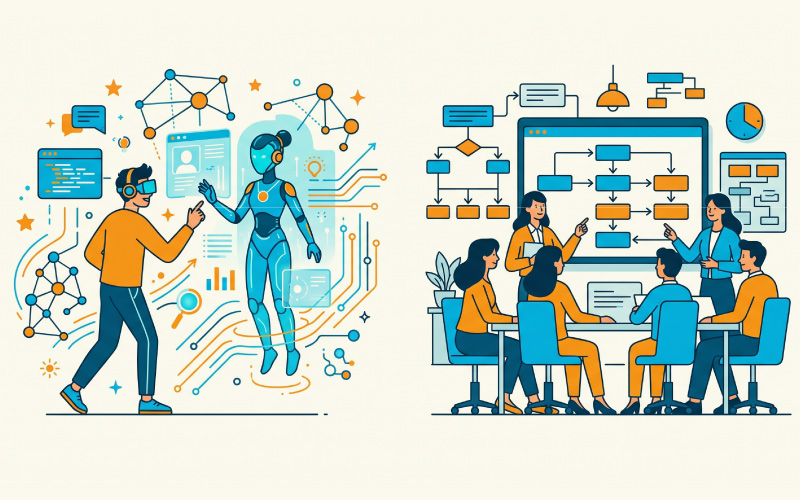
AI role-play simulation uses generative AI to create dynamic, unscripted conversational practice. The AI counterpart responds to what your learner actually says, not to which option they selected. It objects, redirects, and adapts in real time.
This is not a smarter branching scenario. It is a fundamentally different training category.
Three Mechanics That Make It Different
Adaptive dialogue. The AI responds to open-ended input and shifts based on the direction the conversation takes. No fixed paths. No pre-authored menus.
Real-time feedback. Instead of a summary at the end, learners receive coaching signals during and immediately after the interaction. The feedback loop is tight, which accelerates skill development.
Performance analytics beyond completion. The system captures what was said, how it was framed, where the conversation broke down, and what patterns emerge across your cohort. That data is something traditional SBL simply cannot produce.
One thing AI role-play simulation does not do: it does not replace human coaches, mentors, or facilitators. It handles the practice volume that humans cannot sustainably deliver. Your L&D team’s expertise stays essential.

How AI Role-Play Simulation and Scenario-Based Learning Actually Compare
Traditional scenario-based learning and AI role-play training are not two versions of the same thing. They solve different problems, measure different outcomes, and serve different skill types. Here is where they actually diverge across the dimensions that matter to enterprise L&D.
Scroll right to read more.
| Content Type | Dimension | Traditional SBL |
|---|---|---|
| Feedback timing | End of scenario | Real-time, mid-conversation |
| Learner path | Pre-authored branching | Adaptive to actual response |
| Practice volume | Limited by facilitator time | Unlimited, on-demand |
| Consistency | Varies by facilitator | Standardized across cohorts |
| Skill measured | Decision recognition | Conversational performance |
| Content updates | Weeks to revise | Configurable rapidly |
Sensitivity of content. Does this content contain proprietary information, internal data, or cultural nuance that requires deep organizational knowledge to get right?

AI Role-Play Simulation for Enterprise Training: Use Cases Where It Wins
Sales Training: Building Real Pressure, Not Scripted Options
Traditional SBL gives your reps a menu of objections to choose from. AI role-play throws an unanticipated objection mid-pitch and waits for a real, constructed response. That gap between selecting an answer and building one is exactly where most sales training loses its transfer value.
Think about what that means at scale. You need 500 reps across 20 markets certified before a product launch. Traditional SBL cannot deliver consistent conversational readiness at that volume within a compressed window. AI role-play simulation can.
Leadership Development: Where Branching Logic Fails Structurally
Leadership scenarios are ambiguous by nature. The right response to a performance conversation depends on tone, timing, and empathy. No amount of better instructional design closes that gap. It is a structural mismatch between the format and the skill.
AI role-play simulation evaluates not just what your leaders say, but how they say it: pacing, word choice, the presence of acknowledgment before redirection. These are the dimensions that separate effective leaders from technically correct ones. If building your leadership bench is a strategic priority, your training program needs to be able to measure this.
Compliance Training: Closing the Recognition-Application Gap
Most enterprise compliance training asks: Can the learner identify the correct policy response? That is recognition. What real compliance failures expose is something different: employees who knew the policy but could not hold to it when someone pushed back, offered a workaround, or created social pressure.
AI role-play simulation creates that pressure in a safe environment. A compliance scenario where the counterpart actively resists, rationalizes an exception, or introduces urgency is impossible to replicate in a branching scenario.

When Scenario-Based Learning Still Works Better Than AI Role-Play Simulation
Honest advice means saying this clearly: AI role-play training is not the right fit for every training problem.
Traditional SBL still performs well when:
- The skill is process-based, not conversation-based (IT troubleshooting, system navigation, structured onboarding checklists)
- Your training population has limited technology access or low digital fluency
- The compliance objective is genuine recognition of a rule, not its real-time application
- Content is stable enough that update lag is not a risk
The deciding question is not “which is newer.” It is “which format matches the nature of the skill you are trying to build?”

How to Evaluate If Your Organization Is Ready for AI Role-Play Simulation Training
Before you evaluate platforms, answer these five questions. They tell you whether AI role-play training will generate return or generate friction.
- Skill type: Are your employee training conversation-based or judgment-based skills? If yes, this is where AI roleplay earns its value.
- Volume: Do you need to train 200 or more learners on the same interpersonal skill within a consistent delivery window?
- Consistency: Is facilitator-led feedback quality a known variable in your current program?
- Measurement: Can you currently capture what a learner does in a scenario beyond completion rate?
- Infrastructure: Does your LMS or LXP support xAPI or SCORM integration with external simulation tools?
Three or more gaps here signals that a structured proof-of-concept, tied to a specific skill gap and a measurable business outcome, is worth pursuing.

Building the Business Case: What ROI Actually Looks Like
Skip the inflated vendor numbers. Build your training ROI case across three grounded dimensions.
Efficiency ROI: Reduction in facilitator time, travel, and venue cost. AI-powered training helps new hires reach full productivity approximately 30% faster than traditional approaches. Calculate what your average ramp cost is and apply that figure.
Performance ROI: Connect training to the business metric the skill is meant to move. Close rate for sales. Audit pass rate for compliance. 360-degree scores for leadership. Set a baseline before deployment. Define what a 10% improvement in each metric is worth annually. That is your ROI floor.
At Mitr Learning and Media, we build enterprise learning solutions that go beyond content delivery. If AI role-play simulation is the direction your L&D strategy is heading, our product PersonaTrain.ai gives you a practical starting point. It is a no-code role-play builder that turns your SOPs, policies, and product guides into adaptive conversational learning simulations, with real-time feedback and analytics built in. No actors. No facilitators. No static scripts. Just practice that mirrors the real thing, at an enterprise scale.
See what an AI role-play simulation looks like inside your training program. Let’s talk about what PersonaTrain.ai can do for your teams.

Frequently Asked Questions
What is the difference between AI role-play simulation and scenario-based learning?
Scenario-based learning presents pre-authored choices within a fixed decision tree. AI role-play simulation responds to open-ended, unscripted learner input using generative AI. The core difference is between selecting a response and constructing one under real conversational pressure.
Which enterprise training use cases benefit most from AI role-play simulation?
Sales enablement, leadership development, and compliance training generate the strongest results. All three require applied conversational judgment, not recognition of correct answers. Process-based or system navigation training sees far less uplift.
How long does enterprise AI role-play simulation implementation typically take?
Most enterprise deployments move from scoping to pilot in six to twelve weeks, depending on LMS integration requirements, scenario design complexity, and security or data governance review processes.
Can AI role-play simulation replace human trainers and facilitators?
No. It handles practice volume and consistency at a scale human facilitators cannot sustain. Human trainers remain essential for coaching, contextual judgment, and career development conversations that AI cannot replicate.
Organizations that adopt learning engineering gain clearer visibility into workforce readiness. They move beyond course completion metrics. Learning becomes a performance system.