

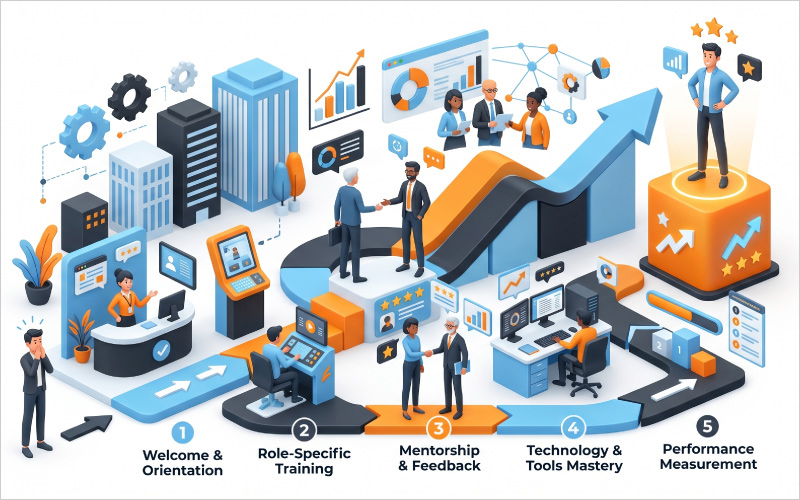
There is a cost most enterprises refuse to calculate: the daily revenue loss between a new hire’s start date and the day they begin contributing meaningfully. Analysts call it the “productivity tax.” CFOs rarely see it on a dashboard, but it shows up in missed targets, overextended teams, and early attrition.
Research by William G. Bliss, supported by multiple workforce studies, shows that the average new employee does not reach full productivity until the fifth or sixth month. For a $90,000 annual salary, that translates to roughly $22,500 paid before full performance is realized. Multiply this across 50 hires per year, and it becomes a board-level concern rather than an HR metric.
Organizations that close this gap fastest share a common approach. They treat onboarding as a structured onboarding training program focused on a single outcome: faster time-to-productivity (TTP).
This is not about better tools. It is about better system design.

Why Enterprise Onboarding Programs Fail to Reduce Time-to-Productivity
Enterprise onboarding is often fragmented. HR handles orientation, IT manages access, managers drive role training, and compliance runs separate sessions. No one owns the full experience, leaving new hires to piece it together.
At scale, this fragmentation creates real business drag. A company onboarding 200 employees annually with a 90-day time-to-productivity slows output across teams. Without a unified framework, organizations end up with inconsistent performance, uneven compliance readiness, and higher early attrition.
Three systemic failure points drive this extended time-to-productivity:
Fragmented delivery
Onboarding training is scattered across emails, folders, recordings, and sessions. There’s no structured path, no scaffolding, and no reinforcement.
Role-agnostic design
One-size onboarding fails across roles. Managers fill gaps informally, creating inconsistency and productivity loss.
No output-driven measurement
Most track completion, not performance. Without defining productivity by role, TTP remains unmeasurable—and unmanaged.

What Is Time-to-Productivity (TTP) in Employee Onboarding?
Time-to-productivity (TTP) is defined as the number of days from a new hire’s start date to independent role performance.
TTP = Productivity Milestone − Start Date
The challenge is not the formula but defining the milestone. This requires alignment across HR, L&D, and business leaders.
Example milestones:
- Customer support: Handles target ticket volume at required CSAT independently
- Sales: Achieves quota without deal-by-deal coaching
- Engineering: Ships a production-ready deliverable independently

Structured Digital Onboarding Program Framework for Faster Productivity
A high-performance onboarding program has a specific anatomy. It is not a checklist extended into digital format. It is a sequenced learning system designed around role-specific competency milestones.
Stage 1: Pre-Boarding Process to Accelerate Employee Productivity
Onboarding begins before day one. Effective preboarding sets context, ensures system access, introduces key stakeholders, and starts compliance early. This allows the first week to focus on role activation instead of administrative delays.
Stage 2: First 30 Days Onboarding Plan for New Employees
The first month should be sequenced, not overloaded. Focus on three areas:
- Organizational context to align roles with business outcomes
- Tools and systems training aligned to real tasks
- Clear performance expectations for 30, 60, and 90 days
Without defined expectations, new hires rely on inconsistent signals.
Stage 3: 60–90 Day Performance Checkpoints to Measure Productivity
Onboarding extends beyond the first month.
- 60 days: Assess role-specific competency and address gaps
- 90 days: Conduct a structured performance review to confirm trajectory
This ensures progress is measured against outcomes, not completion.
Stage 4: Continuous Learning Strategy for Long-Term Employee Performance
Onboarding should transition into ongoing employee training and development. Connecting early learning to long-term growth creates clarity, consistency, and stronger retention.

Why Onboarding Content Design Impacts Time-to-Productivity More Than Technology
Most digital onboarding programs fail not because of tools, but because of content. Organizations invest in platforms, then fill them with static decks, recordings, and policy documents designed for reference, not retention.
Effective onboarding training content follows a different approach:
Scenario-based learning
Simulate real role situations. This builds execution capability, not just theoretical understanding.
Spaced reinforcement
Learning should not be one-time. Use structured follow-ups like quick assessments or microlearning to reinforce retention.
Right modality for the task
Match format to complexity. Policies work as concise reads, workflows need guided demos, and behavioral skills require interactive scenarios.
Scalable localization
Global training programs for employees need more than translation. Content must reflect regional regulations, roles, and workplace context through a defined governance model.

How to Measure Time-to-Productivity in Enterprise Onboarding Programs
Measuring TTP effectively requires four components most organizations lack:
Defined productivity milestones by role family
Group roles into categories such as client-facing, technical, operational, and managerial. Set clear performance thresholds in collaboration with line managers, not in isolation.
Baseline data collection
Measure current TTP before redesigning onboarding. This baseline provides a reference point for evaluating impact.
Onboarding-to-performance linkage
Connect LMS learning data with HRIS or performance systems. This reveals which onboarding elements actually drive faster proficiency.
Cohort-level analysis
Compare TTP across cohorts. Analyze variations by program, manager, and work environment to identify what drives or delays productivity.

How to Calculate ROI of Employee Onboarding Programs
HR and L&D leaders often lack a clear financial model to justify onboarding investment. This framework simplifies the business case:
Step 1: Calculate current productivity loss
Identify average TTP for key roles. Multiply excess days by the daily loaded labor cost. This gives the productivity cost per hire.
Step 2: Model the improvement scenario
Estimate TTP reduction and apply it across annual hires. Multiply saved days by daily cost to quantify productivity recovery.
Step 3: Add retention impact
Improved onboarding increases first-year retention. Factor in replacement costs to capture additional savings.
Step 4: Subtract program investment
Include content development, platform costs, manager time, and L&D effort. The result is your onboarding ROI, expressed as a ratio that supports executive decision-making.

A Practical Roadmap for Enterprise L&D and HR Leaders
Building an enterprise onboarding program requires a phased approach:
Quarter 1: Audit and baseline
Map the current onboarding journey for key roles. Identify gaps, ownership issues, and establish TTP baselines. Gather insights from new hires at 30, 60, and 90 days.
Quarter 2: Design and build
Define role-specific productivity milestones. Redesign content using scenario-based and task-aligned formats. Build structured preboarding and 30-60-90 day journeys.
Quarter 3: Launch and instrument
Pilot the program. Link learning data to performance outcomes. Set manager accountability for check-ins and track progress at 60 and 90 days.
Quarter 4: Measure and scale
Compare pilot results with existing benchmarks. Identify what worked, establish governance, and scale across roles.
Sustainable TTP improvement comes from alignment, clear milestones, and disciplined execution, not speed.

FAQs: Time-to-Productivity (TTP) and Employee Onboarding
What is time-to-productivity (TTP) in employee onboarding?
Time-to-productivity (TTP) is the number of days from a new hire’s start date to the point they perform their role independently at the expected standard. It requires a clearly defined milestone such as quota achievement, ticket resolution volume, or delivery of a complete task.
What is the biggest mistake in onboarding design?
Fragmented ownership. When HR, IT, L&D, and managers operate independently, onboarding becomes inconsistent. One function should own the end-to-end experience with clear accountability.
How should onboarding differ for remote or hybrid employees?
Remote onboarding requires a stronger structure for collaboration and knowledge access. Buddy programs, cohort engagement, and centralized knowledge systems help maintain alignment and reduce disengagement.
Why does digital onboarding fail to reduce TTP?
The issue is usually content design, not technology. Many organizations rely on static documents and recorded sessions that do not support retention. Scenario-based learning, reinforcement, and role-specific sequencing drive better outcomes.
When should companies invest in AI-powered onboarding tools?
After establishing a strong onboarding framework. AI adds value in content delivery, workflow automation, and risk detection only when milestones and content design are already well defined.
Reducing time-to-productivity is not a function of tools alone. It requires a deliberate approach to onboarding training, aligned with business outcomes and built on strong employee training and development principles. Organizations that treat onboarding as a structured, measurable system consistently outperform those that approach it as a checklist.
This is where Mitr Learning and Media brings proven expertise. From designing role-specific onboarding architectures to building scenario-based content and measurement frameworks, we partner with enterprises to create onboarding programs that drive faster productivity and measurable training ROI.
If you are looking to reduce ramp-up time and improve workforce performance, it starts with the right system.
Schedule a consultation with Mitr Learning and Media to evaluate and transform your onboarding strategy.