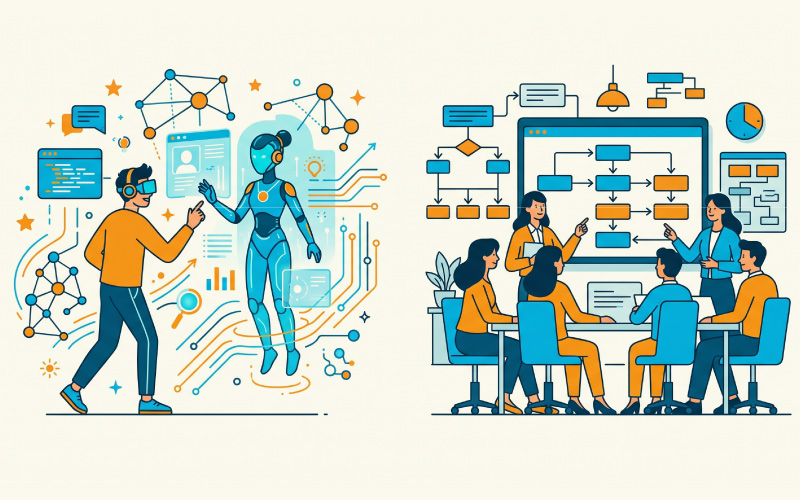

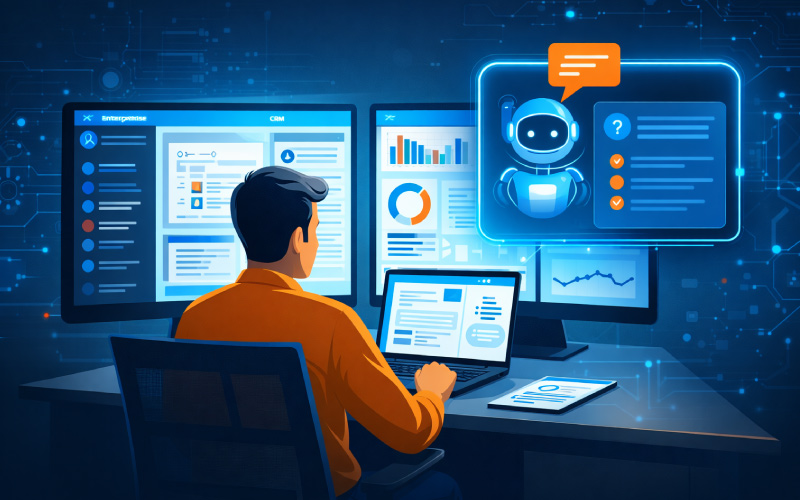
Enterprise training continues to change as organizations adopt new digital tools and workflows. Employees now work across CRM systems, compliance platforms, operational dashboards, and internal knowledge bases. These environments demand quick decisions and accurate execution.
Employees often need the right information while performing tasks. Waiting for the next training session does not help in many real situations.
This shift has increased interest in AI agents designed for workforce learning, often referred to as AI learning agents. In many organizations, these systems sit inside tools employees already use. The AI agent surfaces relevant knowledge at the moment employees need it. It provides guidance without forcing them to leave their workflow.
What Are AI Learning Agents?
AI learning agents are intelligent systems that provide contextual knowledge, task guidance, and personalized learning support within enterprise workflows. They analyze user roles, workflow activity, and skill gaps. Based on this context, they deliver real-time guidance.
Unlike traditional training programs or chatbots, these learning agents function as AI knowledge assistants that reinforce learning during work. They help employees retrieve information and apply knowledge while performing tasks.
Organizations usually integrate these systems into tools employees already use. These tools may include CRM platforms, operational dashboards, internal documentation systems, or collaboration environments.
Key Takeaways
- AI learning agents provide real-time support inside employee workflows. Employees can resolve questions while performing tasks.
- They extend learning beyond scheduled training sessions. Support becomes available at the moment work occurs.
- These systems personalize guidance using role context and skill signals. This makes learning support more relevant.
- Organizations can reduce dependency on subject matter experts for routine questions.
- AI learning agents help scale workforce knowledge across distributed teams.

Why Traditional Training Programs Fail to Support Employees During Real Work
Most enterprise training programs follow an event-based structure. Employees complete courses during onboarding, certification cycles, or scheduled learning programs. This model helps distribute knowledge across large teams.
Knowledge retention also declines when employees cannot apply information quickly. Research in learning science shows that information fades without reinforcement. Exact percentages vary across studies and should be verified for current accuracy.
Enterprise workflows have also become more complex. Employees now work across systems that manage sales operations, supply chains, compliance documentation, and analytics.
When employees encounter uncertainty, they often rely on experienced colleagues. Subject matter experts answer many of these questions. Over time, this creates bottlenecks and slows operational processes.
Traditional training focuses on knowledge delivery. Real work requires knowledge access during tasks. Organizations therefore need systems that provide guidance while employees perform their work.
AI Learning Agents vs Chatbots vs AI Copilots: What’s the Difference?
Organizations exploring AI in learning technologies often encounter several tools with similar descriptions. Chatbots, copilots, and AI agents may appear similar at first. Their purpose becomes clearer when their capabilities are compared.
Scroll right to read more.
| Capability | Chatbots | AI Copilots | AI Learning Agents |
|---|---|---|---|
| Primary role | Answer predefined questions | Assist with productivity tasks | Support workforce learning and performance |
| Context awareness | Limited | Moderate | Deep contextual understanding |
| Learning personalization | Basic | Task-based | Skill-based personalization |
| Workflow integration | Low | Medium | High |
| Knowledge reinforcement | None | Limited | Continuous reinforcement |
How AI Learning Agents Provide 24/7 Support Inside Employee Workflows
AI learning agents operate within the systems employees already use. Employees can access guidance whenever they encounter uncertainty during a task. They reduce dependency on subject matter experts by providing employees with instant access to validated knowledge. These systems operate in ways similar to emerging AI copilots used in enterprise software, providing guidance while employees complete tasks.
Several core capabilities enable this support.
Five Capabilities of AI learning assistants
- Context-Aware Assistance The system analyzes the employee’s current activity. It also considers the workflow environment. Based on this context, the system delivers relevant guidance.
- Skill-Based Personalization AI learning agents adjust recommendations based on employee roles and experience levels. They also consider skill gaps.
- Workflow Integration Organizations embed AI learning assistants inside systems such as CRM platforms, ERP environments, and internal documentation tools.
- Continuous Learning Reinforcement The system reinforces knowledge during tasks. It provides reminders, prompts, and explanations when needed.
- Enterprise Knowledge Intelligence AI learning assistants connect multiple organizational knowledge sources. These may include documentation, training materials, and operational guidelines.
Together, these capabilities allow employees to access reliable information without leaving their workflow.
How AI Learning Agents Enable Learning in the Flow of Work
Learning in the flow of work means delivering knowledge during tasks. Traditional learning models separate training from work. Employees attend courses and later try to apply what they learned. The delay often reduces effectiveness. AI learning assistants change this model and strengthen AI workforce learning strategies.
Traditional learning model:
Training → completion → knowledge decay
AI-enabled model:
Workflow → assistance → reinforcement → capability development
Real-Time Answers During Tasks
Employees can ask questions while completing operational steps. The system delivers immediate guidance.
Guidance Inside Enterprise Systems
AI learning agents operate within tools such as CRM systems, documentation platforms, and internal dashboards.
Knowledge Retrieval Without Leaving the Workflow
Employees can access procedures and explanations without switching systems.
Continuous Reinforcement After Formal Training
AI learning assistants reinforce knowledge after employees complete training programs.
This approach aligns with enterprise learning strategies such as workflow learning, performance support systems, and modern productivity tools.

How AI Learning Agents Improve Workforce Performance and Training Outcomes
Organizations evaluate workforce learning initiatives through operational metrics. These metrics show whether employees perform tasks efficiently and accurately.
AI learning assistants influence several important indicators.
Key Metrics
Organizations commonly measure:
- Employee ramp time
- Task accuracy
- Compliance adherence
- Support ticket volume
- SME workload
- Workforce productivity
AI learning agents improve these outcomes by providing guidance during tasks. Employees spend less time searching for information. They spend more time completing work.
Organizations often compare performance indicators before and after implementation. This analysis helps determine whether learning agents improve operational performance.

Frequently Asked Questions
What is an AI learning agent?
An AI learning agent is an intelligent system. It provides contextual knowledge, guidance, and personalized learning support to employees within enterprise workflows.
How are AI learning agents different from chatbots?
Chatbots respond to predefined questions. AI agents analyze roles, workflow context, and skill signals to provide more relevant guidance.
How do AI learning agents personalize learning?
They analyze employee roles, workflow activity, and previous interactions. Based on this information, they recommend relevant guidance.
Can AI learning agents replace traditional training programs?
AI learning agents do not replace formal training. They complement training by reinforcing knowledge during real operational tasks.
Where are AI learning agents used in enterprises?
Organizations embed them in CRM platforms, ERP systems, digital adoption tools, and enterprise knowledge platforms. These systems allow employees to access contextual guidance without interrupting their workflow.
Enterprise learning continues to evolve. Digital workflows are becoming more complex. Employees now work across multiple systems and tools every day. Many organizations recognize clear limitations. Course-based training alone cannot support modern work environments.
AI learning agents offer a complementary approach to AI-driven workforce learning, helping employees apply knowledge during real work.
At Mitr Learning & Media, conversations with clients often return to the same challenge. Teams need access to knowledge while work is happening. Traditional training alone cannot solve that problem. AI-enabled tools are beginning to address this gap by delivering guidance directly within enterprise workflows. They allow employees to find guidance faster and continue working without disruption.
If this is something your organization is considering, our learning experts can help you explore practical approaches. You can reach out to discuss your learning strategy or schedule a conversation.