

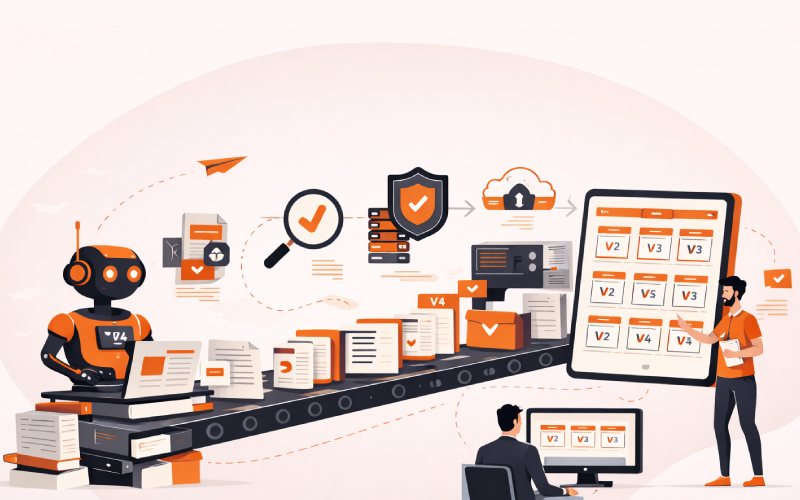
Content production time for a standard 60-minute compliance module dropped from three weeks to three days in one financial services firm after introducing generative AI in L&D. Draft scripts appeared instantly. Slide outlines populated themselves. Assessments were auto generated.
Deployment timelines did not change.
The gap between AI course creation and enterprise training automation remains visible in 2026. Content is faster. Systems are not. The bottleneck moved downstream.

AI Content Creation Is Fast. Enterprise Deployment Is Not.
Generative AI in L&D has reached operational maturity in content drafting. Most enterprise teams now use large language models for initial storyboards, microlearning scripts, policy translations, and knowledge checks. The creation layer has compressed.
The deployment layer has not.
In large US-based enterprises and global organizations, AI course creation feeds into systems that were designed for human-paced publishing cycles. That mismatch creates friction. Content arrives faster than it can be validated, versioned, and distributed across LMS, LXP, CRM-integrated learning tools, and regional compliance portals.
Common friction points emerge quickly:
- Draft content generated in hours still requires structured SME validation.
- Instructional design standards are not automatically enforced by AI outputs.
- Localization workflows remain in manual in regulated regions.
- Metadata tagging and taxonomy alignment are inconsistent across platforms.
The result is a queue. AI accelerates the front end while the back end absorbs shock.
This is where scalable content pipelines become necessary. Without them, generative AI in L&D becomes a drafting tool, not an enterprise training automation solution.
Content acceleration alone does not resolve bottlenecks. Validation is the next constraint.

SME Validation and Review Cycles Are the Real Bottleneck
Enterprises often underestimate the time consumed by review layers. Drafting may take hours. Review takes weeks.
Subject matter experts are not content editors. They work in product, legal, compliance, and operations. When AI course creation increases draft volume, review demand expands proportionally.
Three review-stage realities tend to surface:
First, AI-generated content still requires factual validation. Even with domain-specific prompting, hallucination risk persists. In regulated sectors such as healthcare, finance, or energy, tolerance for inaccuracy is low.
Second, version comparison becomes difficult. When AI regenerates updated modules after policy shifts, SMEs must verify differences between versions. Many systems do not provide structured redlining for learning assets.
Third, approval tracking lacks transparency. Email-based signoffs and disconnected review documents create audit exposure.
In one multinational manufacturing organization, AI reduced content drafting time by 55 percent. Review cycle time increased by 18 percent because SMEs were asked to review more frequently.
The review stage becomes a throughput constraint.
This constraint connects directly to version control. When multiple iterations move through validation at speed, governance becomes fragile.

Version Control in AI-Driven Training Environments Is Often Fragmented
Versioning in enterprise training environments has historically been linear. One course. One update. One approval cycle.
Generative AI disrupts that rhythm. Iterations multiply.
Enterprises now manage:
- Original human-authored modules.
- AI enhanced revisions.
- Region-specific adaptations.
- Policy-triggered updates.
- Archived but audit-relevant versions.
Without structured version control embedded into scalable content pipelines, duplication increases. Teams lose clarity on which module is authoritative.
Consider a compliance program operating across the US and the EU. An AI-generated update reflects a US regulatory adjustment. The EU variant remains unchanged. Six months later, a global audit requests documentation of policy-aligned training. A version of confusion emerges.
Version fragmentation introduces operational and legal risk.
This is not a failure of AI. It is a systems design issue.
BrinX.ai integrates version governance into its workflow logic, ensuring AI-generated updates pass through structured checkpoints, timestamping, and controlled publishing environments. The emphasis is traceability, not speed.
Version control issues naturally expose another layer of enterprise exposure. Compliance and audit risk.

Compliance and Audit Exposure Increase When AI Outputs Lack Governance
AI-generated content introduces additional regulatory scrutiny in enterprise environments. Particularly in US-based industries with federal oversight and global enterprises operating under GDPR, ISO, or industry-specific standards.
Compliance exposure typically arises in four areas:
- Documentation gaps. If organizations cannot demonstrate how AI-generated learning content was reviewed and approved, audit trails weaken.
- Data handling concerns. Generative AI in L&D may process internal policy documents, customer information, or proprietary frameworks. Data governance controls must be documented.
- Localization compliance. Region-specific regulations may require jurisdictional language nuances that generic AI outputs are missing.
- Retention policies. Training records, including content versions, must be stored according to regulatory timelines.
Audit teams increasingly request clarity on AI for use in content production. Not to prohibit it. To verify control.
Enterprise training automation cannot exist without compliance architecture.
When AI content moves directly from draft to LMS without documented transformation, risk accumulates quietly.
This exposure forces organizations to reconsider the underlying architecture of their content pipelines.

Structured Content Transformation Workflows Are the Missing Layer
AI course creation produces raw material. Enterprises require structured transformation.
A structured workflow typically includes:
- Automated formatting into approved instructional design templates.
- SME validation checkpoints embedded into workflow software.
- Version tagging with time-stamped audit trails.
- Metadata enrichment aligned with enterprise taxonomy.
- Deployment routing across regional LMS instances.
Most enterprises have partial elements of this structure. Few have integrated them into a single scalable content pipeline.
The absence of integration leads to manual handoffs between AI tools, content repositories, authoring platforms, and LMS environments. Each handoff introduces delays.
This is not a content generator. It is a pipeline enabler.
When transformation workflows mature, deployment timelines begin to align with drafting speed. Not perfect. But measurably.
The connection between workflow structure and deployment efficiency becomes clearer when examining enterprise training automation more broadly.

Enterprise Training Automation Requires Systemic Alignment, Not Just AI
Automation in enterprise learning environments often focuses narrowly on content generation. True automation includes orchestration across systems.
Enterprise training automation depends on:
- LMS integration logic.
- HRIS data synchronization.
- Role-based assignment triggers.
- Recertification schedule.
- Reporting dashboards aligned with compliance metrics.
AI course creation increases content velocity. It does not inherently synchronize HR data feeds or automate reassignment rules after policy updates. Drafting speed and operational alignment remain in separate concerns.
In one US healthcare enterprise, AI-generated compliance modules were ready within 48 hours. Assignment to affected roles still requires manual HR data extraction and LMS configuration. The bottleneck shifted from authoring to systems of coordination.
Automation requires system connectors.
BrinX.ai integrates with enterprise environments to reduce these configuration gaps, enabling AI-generated content to move through predefined automation rules rather than manual coordination.
The broader pattern becomes clear over time. AI accelerates drafting. Systems determine throughput.
Organizations that treat generative AI in L&D as a standalone solution encounter downstream congestion. Those investing in scalable content pipelines align creation, validation, governance, and deployment within a unified architecture.
There is no single tool that eliminates this complexity. Structured workflows, however, reduce fragmentation.
Content speed without system design creates pressure. Structured pipelines redistribute it.
That redistribution depends on what sits between generation and deployment.
What an Enterprise-Ready AI Content Pipeline Actually Requires
Most organizations experimenting with AI course creation focus on generation models. The operational leverage sits in the layer that converts AI output into governed, enterprise-ready learning assets. That middle layer determines whether generative AI in L&D becomes infrastructure or remains a drafting assistant.
An enterprise-ready AI content pipeline typically includes several structural components, though they are rarely implemented as a unified system.
Structured ingestion of AI outputs into standardized instructional design templates is foundational. When formatting alignment is inconsistent, downstream publishing cycles slow and manual corrections accumulate.
SME validation checkpoints must be embedded directly into the workflow. Review cannot depend on disconnected email threads or informal approvals if traceability and audit readiness are required.
Version tagging with timestamped archival logic becomes essential as AI-generated iterations increase. Without controlled version histories, authoritative content is difficult to identify.
Deployment routing logic aligned with LMS and HRIS systems ensures that content updates trigger appropriate assignment rules. Without this alignment, even approved modules remain operationally static.
These components do not replace generative AI in L&D. They determine whether AI course creation translates into reliable enterprise training automation.
BrinX.ai operates within this transformation layer. The platform structures AI-generated content into compliant, version-controlled assets aligned with enterprise training automation systems. It connects AI course creation workflows to repositories, LMS environments, and reporting frameworks through governed conversion processes.
The focus remains traceability, version integrity, and structured deployment rather than content novelty. For enterprises navigating compliance exposure, audit documentation, and distributed training ecosystems, this structural layer becomes central to scalable content pipelines.
Enterprises investing in this architecture often observe stabilization in review cycles, reduction in version conflicts, and improved audit documentation clarity. The shift is rarely visible during drafting. It becomes measurable at deployment.
Organizations evaluating generative AI in L&D at scale can engage BrinX.ai to assess existing content workflows, identify structural bottlenecks in validation and version control, and implement governed transformation pipelines aligned with enterprise training automation requirements.
To discuss how BrinX.ai can integrate into your AI-driven learning architecture, connect with our team.