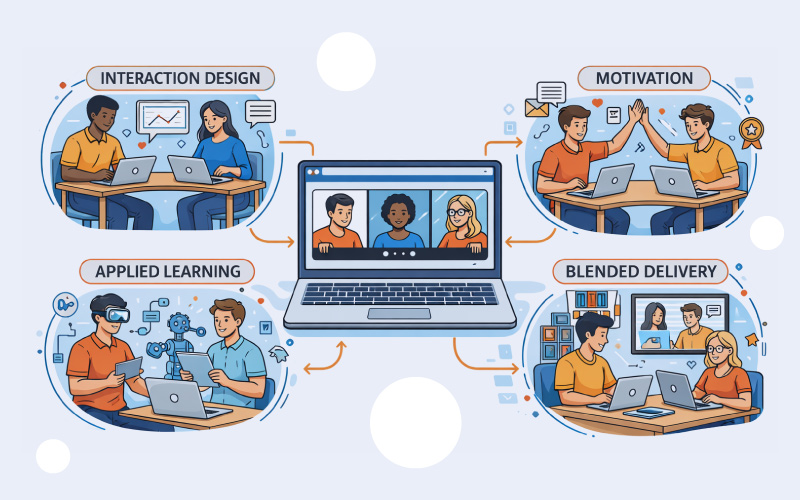

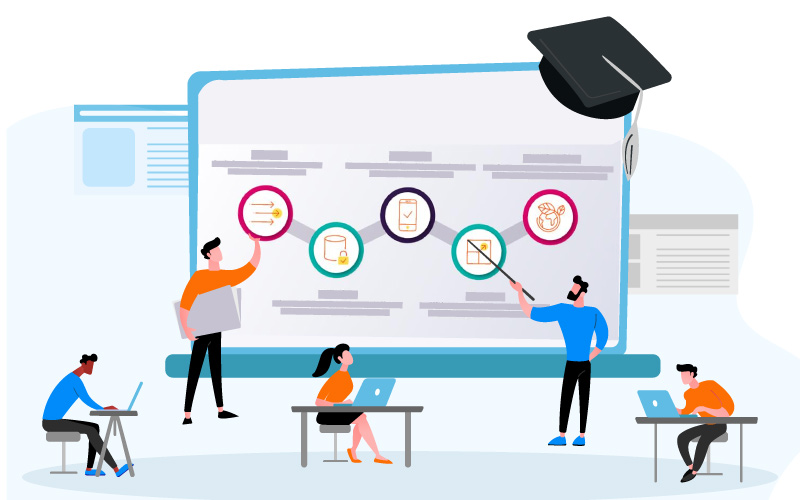
Search patterns over the past year show something shifting. Queries for “learning experience design” and “student engagement strategies” have been increasing in both the EU and the US. Not dramatically, but enough to indicate that institutions are not looking for new systems as much as they are trying to understand what those systems actually produce. A familiar pattern when technology adoption outpaces instructional practice.
Digital transformation in higher education has moved quickly.
The outcomes have not always kept pace. Some platforms were procured to solve operational gaps, others to standardize delivery. Only a fraction was intentionally aligned with the student’s experience. Institutions are now revisiting the question they skipped earlier: What is the lived experience of learning inside these systems.
The discussion often stays abstract. It does not need to. Learning experience design gives the topic a more grounded frame, even if institutions interpret it differently.

The Shift from Digital Delivery to Actual Experience
Most institutions track the usage of metrics. Log-ins, completion rates, activity counts. These indicators are easy to monitor, but they rarely explain the quality of learning or the conditions that shape it. Students may complete content without retaining it, or they may navigate multiple systems that technically function but generate high friction.
Experience gaps often appear in places where teams assumed technology would solve coordination. In several universities, LMS integrations were implemented rapidly during remote transitions. Content migrated efficiently, yet faculty reported students missing key instructions because formats were inconsistent. Version control issues stretched across departments. The learning experience did not degrade because the tools were weak. It degraded because the flow of information was fragmented.
A small pattern emerges here. Digital adoption does not distribute clarity on its own. It only distributes access. This is usually the point where institutions start talking about learning experience design, even if they do not call it that.
The movement from “systems working” to “students navigating them effectively” is never linear. It tends to involve revisiting old processes that were never designed around digital behaviors.
So, the conversation shifts again, toward experience as a design problem rather than a software problem.

How L&D Reframes Institutional Design Decisions
Learning experience design in higher education is not a standardized discipline. It sits somewhere between instructional design, service design, and academic policy. Institutions apply it inconsistently, but the underlying logic stays stable.
It asks a simple question: What inputs shape the actual learning moment.
This leads to a second set of questions that institutions use when they begin restructuring programs:
-
Which parts of the student journey depend on interpretation rather than clear guidance.
-
Which digital interactions require more cognitive effort than the learning task itself.
-
Which feedback loops run slower than the pace at which students need reinforcement.
These questions often expose common patterns. A large university found that students navigated eight separate systems before reaching their core course materials. Another institution tracked assignment feedback cycles and noticed a median delay of twelve days. None of these issues were technical failures.
They were designed for inconsistencies.
When higher-ed teams start examining these details, they usually find that experience issues accumulate slowly. Not through major breakdowns, but through several minor interactions that add friction. A login redirect. A grading rubric hidden under multiple layers. A video that does not match the course’s pacing. The patterns sit in the margins, not the core.
And these margins influence engagement more than most institutions expect.
There is usually a short period of internal discomfort when this becomes visible. Once it does, design teams shift their attention to restructuring learning pathways, aligning digital environments with pedagogy, and standardizing elements that previously evolved independently.
Transitions like these set the stage for broader digital transformation to produce measurable student impact.

Where Digital Learning Systems Support L&D and Where They Do Not
Most enterprise LMS and content platforms support structured delivery. They store content, manage assessments, and enable faculty oversight. This is well understood. What they do not always support is the nuance of experience design.
Three patterns appear repeatedly:
-
Systems manage content flow, not cognitive flow: Students move through modules as the platform defines them, which may not align with how the learning task actually unfolds.
-
Tools optimize administration before pedagogy: Reporting, grading, and compliance features work reliably. Instructional nuances often require workarounds.
-
Interoperability is assumed, not assured: Integrations function at the technical level but miss workflow alignment, which affects pace and continuity.
These patterns are not critiqued.
They are structural characteristics of enterprise systems. Institutions that understand this tend to map experience layers on top of technology layers rather than expecting the platform to address student engagement by default.
When teaching and learning centers run L&D reviews, they frequently discover that students engage more consistently when instructional structure mirrors the logic of the technology environment. Not because technology is ideal, but because predictability reduces friction.
Once this coordination improves, digital transformation efforts begin creating a visible impact. Not immediately, but steadily. A technical upgrade alone rarely changes the student’s experience. A realignment of workflows around that upgrade usually does.
Why Student Engagement Behaves Differently in Digital Contexts
Engagement in higher education is complex. It involves cognitive, behavioral, and relational components. In digital environments, these components shift because time, presence, and feedback operate differently.
A familiar observation: synchronous learning environments create immediacy, while asynchronous environments create autonomy. Students need both, but each requires different forms of instructional signaling.
Engagement patterns often break when those signals are inconsistent across courses. A student may interpret workload incorrectly. They may assume a quiet discussion forum means low expectations. They may wait for clarification that never arrives because the system design treats communication as optional.
Digital transformation introduced more flexibility, which students generally appreciate. It also increased variability. Institutions that adopt learning experience design tend to reduce this variability through clearer pacing, more visible expectations, and simpler learning pathways.
Some institutions document these adjustments explicitly:
-
Mapping communication points into the course structure.
-
Reducing the number of interfaces a student must navigate.
-
Standardizing assignment formats and submission workflows.
These shifts look small on paper. They compress cognitive overhead that distracts them from learning. When applied consistently, they reshape engagement patterns in measurable ways.
For example, an institution in Central Europe linked attendance data with module pacing to identify where asynchronous modules created drop-offs. The lag decreased after reformatting the sequencing. Not because the content changed, but because the pathway became less ambiguous.
Patterns like these repeats in different contexts. The specifics vary, but the underlying principle holds engagement correlates with clarity more than with novelty.
Faculty Workflows Influence Student Experience More Than Expected
Institutions often focus on student behavior first, but faculty workflows shape the learning experience at its foundation. When academic teams manage multiple systems without a unified process, inconsistencies accumulate.
Faculty may upload materials in different formats. They may interpret pacing guidelines differently. Communication practices vary widely even within a single program.
These differences affect students immediately. But they also influence institutional decisions about digital transformation.
When teams begin L&D reviews, they often find that faculty practices determine the actual experience more than the institution’s technology investments. And faculty workflows are influenced by:
-
The usability of instructional tools
-
The clarity of program-level guidelines
-
The supports model provided by learning design teams
A university in the US ran a year-long audit of faculty digital practices. They discovered that once they standardized course templates and provided light-touch design support, student queries dropped noticeably. Retention metrics stabilized in introductory courses, where inconsistency had been highest.
Small structural interventions often produce these outcomes. Nothing dramatic. Just alignment.
This creates a feedback loop between digital transformation and faculty behavior. As workflows stabilize, experience design becomes easier to operationalize.

The Role of Data in Re-Centering the Student Experience
Institutions now gather extensive digital learning data, though much of it sits unused. This is partly due to uncertainty about which metrics actually matter for student experience.
Data becomes actionable when institutions link it to instructional moments. A dataset on login frequency does little. A dataset connecting module access patterns with assignment sequencing reveals where design changes may be necessary. Some institutions learn this quickly; others take several cycles.
Several patterns recur:
-
Experience indicators do not align neatly with completion of metrics.
-
Data without instructional context creates misleading interpretations.
-
Small correlations often signal larger design inconsistencies.
A university in Southern Europe combines navigation logs with course-level engagement rubrics. They identified modules where students returned repeatedly without progressing. The issue was not difficult– it was ambiguity in task instructions. Once clarified, the module stabilized.
Digital transformation gives institutions more data, but not more insight. Learning experience design provides the frame for interpreting these datasets in instructional terms. Without this frame, analytics remain operational rather than pedagogical.
As institutions refine their use of data, they start identifying where digital transformation can drive real student impact rather than peripheral efficiency.

Moving From System-Centered to Student-Centered Digital Models
Many higher education institutions built their digital infrastructure on system logic. It made sense during rapid expansion. Systems were solving administrative and compliance pressures. Student experience was treated as a secondary consideration, sometimes implicitly.
The current shift toward learning experience design is partly a response to this imbalance. Once institutions map the actual learning journey, they often identify misalignments between system workflows and student workflows.
This produces a slower but more intentional form of digital transformation. Teams begin redesigning processes around:
-
Navigation coherence
-
Instructional consistency
-
Clearer communication pathways
-
Reduced cognitive load across the semester
These shifts do not require replacing major systems. They require interpreting them differently. When experience design becomes the lens, digital transformation stops being a technology project and becomes an academic one.
The effects show gradually.
Students spend less time locating materials. Faculty spend less time fielding administrative questions. Programs adopt more predictable structures. Retention indicators move modestly, but reliably.
Digital transformation becomes less about expanding platforms and more about refining the actual learning encounter within those platforms.
Higher education often treats digital change as infrastructure work. Experience design moves closer to instructional work. The distinction matters because student impact emerges in small spaces where design choices, workflows, and digital environments intersect.
Institutions that pay attention to those intersections tend to see steadier gains, even if the improvements appear incremental.
FAQ's
Why is accessibility essential to STEM education for students with special needs?
Accessibility to STEM eLearning means that all students (of both genders and with special needs) get to be partakers of learning programs. It's a step towards eliminating educational inequalities and fostering multiverse innovation.
In STEM education, what are some common problems encountered by students with special needs?
Some common issues are course format that is not complex, non-adapted labs and visuals, insufficient assistive technologies, and no customized learning resources. Besides this, systemic issues such as learning materials that are not inclusive, and teachers who are not trained.
How can accessibility be improved in STEM eLearning through Universal Design for Learning (UDL)?
Through flexible teaching and assessment methods, UDL improves accessibility in STEM content. Also, UDL allows learners to access and engage content in multiple ways and demonstrate understanding of content.
What are effective multisensory learning strategies for accessible STEM education?
Examples of multisensory learning strategies in accessible STEM include when students use graphs with alt-text, auditory descriptions of course materials, tactile models for visual learners through touch, captioned videos for auditory learners, and interactive simulations to allow boys and girls choice in how they have access to physical, visual, auditory, video and written content representation.
Identify the assistive technologies required for providing accessible STEM material?
In order to provide access to STEM material, technologies like screen readers, specially designed input app for mathematics, braille displays, accessible graphing calculators are required.
How can STEM educators approach designing assessments for students with special needs?
To create content for students with special needs, tactics such as creating adaptive learning pathways in more than one format, oral and project assessments and multiway feedback will prove to be beneficial.
What is the role of schools and policymakers in supporting accessible STEM education?
Educational institutions should focus on educating trainers and support staff, also they can invest in assistive technology, and work towards curricular policies.
Can you share examples of successful accessible STEM education initiatives?
Initiatives like PhET Interactive Simulations, Khan Academy accessible learning resources, Labster virtual laboratory simulations, and Girls Who Code’s outreach are examples of effective practice.
How can Mitr Media assist in creating accessible STEM educational content?
Mitr Media is focused on designing and building inclusive e-learning platforms and multimedia materials with accessibility standards in mind so that STEM material is usable by all learners at different levels of need.
What value does partner with Mitr Media bring to institutions aiming for inclusive STEM education?
Mitr Media has expertise in implementing assistive technology, enacting Universal Design for Learning, and providing ongoing support to transformation organizations, enabling their STEM curriculum into an accessible and interesting learning experience.