

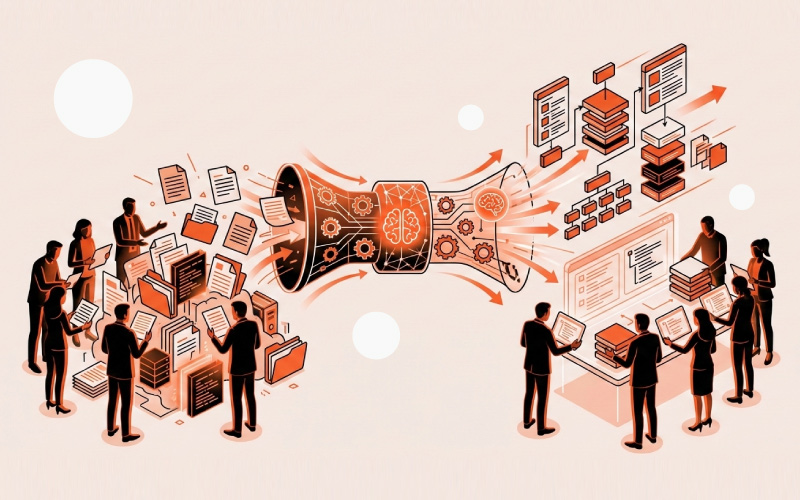
In 2025, enterprise L&D operations data showed that between 35% and 45% of total project time is spent before any instructional decisions are made, largely on content structuring and preparation work.
In practice, this time is not spent designing learning as much as organizing inputs. Policies arrive as PDFs; slide decks come from different business units, and reference documents reflect different update cycles.
Before outcomes or assessments enter the conversation, designers are already reconciling versions, grouping material, and deciding what actually belongs together. This work rarely appears in formal plans, yet it consistently shapes delivery timelines across large learning teams.
The focus of this blog is on how learning content is structured inside enterprise environments, and how that structure changes once AI becomes part of the workflow.

Where Manual Instructional Design Slows Down in Enterprise Learning Programs
In enterprise learning programs, delays rarely begin with instructional decisions themselves. They surface earlier, often when teams first open the material they have been handed and try to make sense of it together. Content arrives from different functions, built for compliance checks, operational reference, or internal circulation, and very little of it is shaped with learning flow in mind.
As designers start reviewing these inputs, the work shifts quickly toward interpretation. One document reflects last quarter’s process; another uses different terminology for the same step, and a third overlaps just enough to create confusion. Time goes into deciding what is current, what conflicts, and what can be trusted before anything resembling design can move forward.
Across projects, this organizing work repeats. Documents have to be aligned to a common structure, language standardized, so concepts stay consistent, and gaps identified only after materials are placed side by side. When subject matter experts reintroduce updates midway through, the cycle extends again.
Seen over time, the slowdown points to how content enters systems, long before design choices are even on the table.

Why Speed Becomes a Structural Question, not a Talent Issue
When delivery timelines slip, the explanation often turns toward talent, more designers, stronger skills, or better tools. In day-to-day work, that answer rarely settles the question. Many enterprise teams already have capable instructional designers, yet projects are still slow once content begins moving between functions, reviewers, and systems, where the process itself starts to matter.
You see it when a policy update arrives after outlines are approved, or when two business units submit similar material using different terminology. Designers pause to reconcile meaning; reviewers reopen decisions, and momentum fades, not because anyone is unsure, but because the structure has not held.
Over multiple programs, the same pressure points surface in familiar ways. Handoffs between content owners and design teams stretch longer than expected. Reviews overlap without a shared source of truth. Late content changes reset earlier decisions. Sequencing remains unclear. Visibility into how modules connect across programs stays limited.
At that point, speed stops being personal, and attention shifts toward recognizing repeatable structural patterns early.

What AI Actually Does When It Structures Learning Content
AI enters the learning workflow earlier than most teams expect, usually at the point when content still feels unmanageable rather than instructional. At that stage, the challenge is not deciding how to teach but understanding what exists and whether it can be shaped into something coherent enough to design against.
Most enterprise content lives in documents created for other purposes. When AI in eLearning development workflow structure learning content, they work through these sources first, identifying how material naturally breaks apart and where meaning repeats or drifts. Designers often recognize these patterns immediately, but until they are visible, progress stays slow.
Common outputs from this stage include:
-
Learning units grouped by underlying concept rather than file type
-
Duplicated explanations surfaced before they create redundancy
-
Outdated references identified across otherwise current material
-
Terminology differences flagged where the same idea appears under different labels
-
Topic boundaries revealed where documents blend multiple ideas
Once this structure exists, relationships between units begin to surface, which is why documents, not platforms, become the logical starting point for sequence and dependency decisions.

Automated Structuring from Documents Changes the Timeline
Once document-to-structure automation becomes part of the workflow, the early phase of a learning project starts to feel different almost immediately. Teams no longer wait for content to “settle” before moving ahead. Structure begins to form while material is still being reviewed, which shifts how time is spent in the first few weeks.
Consider a typical intake. Policies arrive from compliance; slide decks come from operations, and reference notes reflect different points in time. Traditionally, designers pause until these inputs are reconciled. With automated structuring, documents are decomposed as they come in. Overlaps surface early. Gaps become visible before outlines are finalized. The work that once happened in sequence begins to happen in parallel.
This is where AI-driven instructional design systems like BrinX.ai operate, focused on automated structuring from existing documents rather than authoring content. Teams gain earlier visibility into how material connects, which reduces repeated normalization cycles, shortens review loops, and absorbs late updates with less disruption.
Over time, timelines compress not because anyone works faster, but because less effort is spent revisiting the same organizational questions. That clarity sets up the next shift, where secondary effects begin to matter more than raw speed.

How Faster Content Structuring Changes Reviews, Iterations, and Governance Outcomes
When content is structured earlier, the most noticeable changes tend to surface downstream rather than at intake. Speed improves, but more importantly, the work stops circling familiar problems. Teams spend less time revisiting decisions that were never fully grounded, and more time responding to visible structures that everyone can see and reference.
Several secondary effects show up repeatedly once this shift takes hold:
-
Iteration cycles narrow as feedback attaches to stable structure rather than evolving content.
-
Review conversations sharpen once comments reference defined units.
-
Governance questions surface earlier, while change is still manageable.
-
Exceptions decrease as dependencies become visible upfront.
-
Approval paths shorten when assumptions remain explicit.
These changes compound across programs. Still, structuring only goes so far, which makes the boundary between automation and judgment increasingly important to examine.

The Boundary Between Automation and Instructional Judgment
Automation reaches a natural stopping point once content has been structured and made visible.
At that stage, relationships that were previously buried begin to show themselves. Overlaps become visible, dependencies are easier to trace, and inconsistencies stop blending into the background noise of documentation.
Decisions about emphasis, simplification, or omission still come later. They emerge when teams start weighing who the content is for, what risks are involved, and how closely the material aligns with real operating conditions, not from the structure alone.
Unstructured material > Content organization > Pattern visibility > Instructional judgment
That progression becomes clear in everyday work. A policy can be accurate and still unsuitable for a frontline audience. A process description may be complete yet misaligned with how work actually happens.
Automation accelerates the move toward clarity, but judgment enters only after structure exists, grounded in consequence, experience, and institutional understanding rather than pattern recognition alone.

A Stable View of How Learning Design Work Is Rebalanced
Once automated structuring becomes part of the workflow, the shape of learning design work begins to stabilize in ways that feel operational rather than dramatic. Designers spend less time preparing content to be usable and more time working with material that already has form, while reviews shift earlier toward intent, relevance, and appropriateness instead of basic organization. Governance conversations also move closer to the point where structure is first visible, rather than appearing late as corrective measures after decisions have already been made.
In this context, systems like BrinX.ai tend to operate quietly in the background. By applying AI-driven instructional design to existing documents, BrinX.ai supports earlier structuring without stepping into authoring or instructional judgment, allowing teams to see relationships, gaps, and dependencies sooner and reduce the repeated reconciliation that often slows early phases of work.
Over time, effort redistributes rather than disappears, with structural work moving earlier and judgment becoming clearer and more deliberate. To explore how document-to-structure automation can support this shift in your learning environment, contact BrinX.ai today.
Frequently Asked Questions
In this context, systems like BrinX.ai tend to operate quietly in the background. By applying AI-driven instructional design to existing documents, BrinX.ai supports earlier structuring without stepping into authoring or instructional judgment, allowing teams to see relationships, gaps, and dependencies sooner and reduce the repeated reconciliation that often slows early phases of work.
Will I lose my content rights if I use an AI tool?
It depends on the tool. Some platforms lock your content inside their system. A better option is a platform like BrinX.ai that lets you export SCORM files. You own those files completely. You can upload them to any LMS and access them even if you stop using the tool.
Does AI-generated training follow accessibility rules?
Yes. AI helps improve accessibility in eLearning. It can add image descriptions and create captions for videos or flag color contrast issues that make content hard to read. Using AI makes it easier to meet WCAG accessibility standards when you manage a large number of courses.
How do you use AI to measure the ROI of training programs?
AI connects learning data with on-the-job performance. It shows which parts of a course help people perform better and which parts slow them down. This gives learning teams clear data to share with leadership. Instead of assumptions, you can show how training supports real business outcomes.
How much can I save by using AI-supported course development?
Many teams reduce development costs by 50% to 70%. Traditional course creation takes a lot of time because teams plan, structure, and format everything manually. AI handles much of this early work quickly. As a result, teams create more training without increasing their budget.
How do I pick the right AI tool for my organization?
Focus on three things: workflow fit, export options, and security. The tool should work with your existing process and allow exports in formats like SCORM. Security matters most. Choose a platform built for learning teams, like BrinX.ai, that keeps your data private and does not share it with public AI models.

Soft Skills Deserve a Smarter Solution
Soft skills training is more than simply information. It is about influencing how individuals think, feel, and act at work, with coworkers, clients, and leaders. That requires intention, nuance, and trust.