

When a Learning Stack Looks Impressive but Feels Unclear
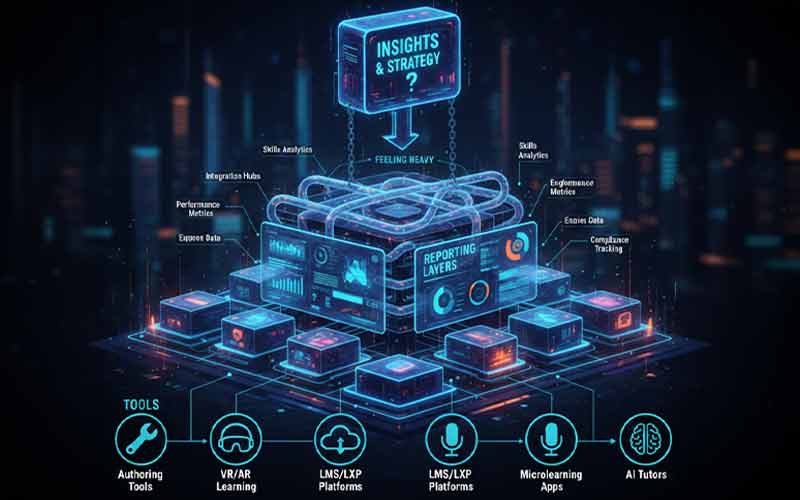
In 2026, it is not unusual for large enterprises to operate six to twelve learning-related platforms within a single ecosystem, a pattern reflected in Brandon Hall Group research over recent years. An LMS anchors the environment. An experience layer extends access. A skills platform feeds mobility program. Separate analytics tools attempt to unify reporting. Most of these additions were made with intent. Few replaced what came before them.
The tension appears in executive reviews. Completion rates are visible. Engagement dashboards updated reliably. When leadership asks how the full stack is shaping capability readiness across priority roles, the answer often requires pulling data from multiple systems and aligning it manually. The tools’ function. Direction remains unclear.
This is where weight begins. Not in system failure, but in daily friction and unclear signal.
This blog examines why heaviness has intensified in 2026 and what shifts are required to move from tool accumulation to insight direction.

How Digital Friction Slows Enterprise eLearning Workflows in 2026
Friction does not usually appear during procurement. It shows up a week before performance reviews, when a manager logs into the LMS to check completions, then opens a skills platform to review proficiency tags, and finally accesses a separate dashboard to prepare for a talent discussion. None of these steps are complex on their own. The time accumulates in the switching.
L&D teams experience it differently. Ahead of quarterly business reviews, data is exported from multiple systems and aligned manually to answer what appears to be a simple question about readiness. In one enterprise environment, consolidating three reporting streams required roughly 10 to 12 hours of preparation before each executive meeting. The tools were technically integrated. The interpretation was not correct.
The pattern often includes:
- Parallel dashboards tracking similar engagement metrics
- Multiple logins across LMS, skills systems, and analytics layers
- Manual reconciliation before executive reporting
- Duplicate content libraries maintained in separate platforms
Friction compounds quietly. It does not announce itself as a failure. It settles into a routine workflow.
Reducing that friction, however, does not automatically produce clarity. A streamlined stack can still generate activity without direction. That realization is what is pushing many 2026 conversations toward ecosystem consolidation rather than incremental tool adjustments.

Why 2026 Is Driving eLearning Ecosystem Consolidation Conversations
Consolidation is not emerging as a trend because tools suddenly stopped working. It is surfacing in budget meetings, renewal cycles, and procurement reviews where overlap becomes difficult to ignore. Over the past two years, enterprises kept adding tools to improve visibility skills, support mobility programs, and get better reporting clarity. In 2026, many of those systems now sit next to each other, sometimes measuring similar things in slightly different ways.
Consolidation Is Often Triggered by Budget Reviews
Vendor renewals now come with closer scrutiny. Finance teams are asking where capabilities overlap and whether parallel platforms justify parallel costs. In several enterprise environments, similar engagement metrics are reported across two systems, each with its own licensing structure. The question is not whether either tool works. It is whether both are necessary in their current configuration. Consolidation conversations often begin there, not as strategy, but as fiscal hygiene.
Fewer Tools Do Not Guarantee Clearer Insight
Reducing vendor counts can simplify contracts without improving clarity. If reporting logic remains unchanged, the organization may still track activity rather than progression. The completion of dashboards remains intact. Capability direction remains ambiguous.
In consolidation workshops, MITR Learning and Media begins by mapping how learning data moves across systems before discussing vendor reduction. The focus is on identifying where signals fragment, where definitions differ, and reporting logic duplicates in effort. Only after clarifying what the ecosystem is expected to indicate about role readiness and capability progression does the conversation turn to which tools genuinely support that objective.
This approach shifts consolidation away from contract rationalization and toward signal design. Vendor reduction alone does not resolve direction. The deeper shift involves redefining what the learning ecosystem is meant to indicate workforce capability, then restructuring systems to align with that definition. That distinction becomes central when moving from activity reporting toward capability direction.

Moving from Activity Metrics to Capability Direction
In several enterprise dashboards, completion rates have risen steadily over the past three years. Course consumption is higher. Engagement indicators trend upward. Yet when leadership asks whether readiness for critical roles has improved, the answer is often indirect. Activity is visible. Progression is inferred.
Activity metrics, by design, measure participation. They indicate what was accessed, completed, or rated. They do not automatically reflect whether capability is advancing toward a defined standard. Capability direction requires something more deliberate. It depends on linking learning pathways to clearly articulated role outcomes and then observing movement against those expectations over time.
In one higher education institution, learning paths were aligned directly to role benchmarks across academic leadership positions. Once those benchmarks were embedded into reporting logic, lag in readiness tracking decreased by approximately 40 percent because data no longer required cross-system interpretation before discussion. The change did not involve additional tools. It involved signal alignment.
Excess data complicates this shift. When multiple dashboards surface overlapping metrics without hierarchy, attention disperses. Tracking what happened remains straightforward. Understanding where capability is heading requires prioritizing specific indicators over general engagement volume.
That distinction pushes the conversation beyond tooling. It introduces a design question. If the ecosystem is expected to indicate trajectory rather than activity, then structure, ownership, and reporting logic must be reconsidered before any new technology is introduced.

Designing eLearning Ecosystems That Produce Insight, Not Volume
Once activity is separated from direction, the design question becomes practical. Governance needs to come before procurement. When capability indicators are unclear, adding tools increases reporting surface without improving what leaders can actually interpret.
Ownership of capability metrics cannot remain implied. Readiness definitions, progression thresholds, and reporting expectations require explicit agreement. Without that clarity, dashboards expand and signal weakens. Reporting grows heavier, not sharper.
Reporting architecture should be clarified before expansion. Tool decisions then move away from feature comparison and toward contribution. The question becomes straightforward: does the system improve visibility into progression, or does it add another layer of activity data?
MITR Learning and Media works with enterprise L&D and HR leaders to realign learning ecosystems around defined capability outcomes rather than platform features. The work starts by reviewing how data moves across LMS environments, skills systems, content providers, and reporting dashboards to locate duplication and signal gaps.
Capability benchmarks for priority roles are clarified. Reporting hierarchies is structured. Only after that alignment are tool configurations examined for consolidation or integration of refinement. Technology decisions follow capability architecture.
If your 2026 learning stack feels operationally heavy but strategically unclear, it may be time to reassess the ecosystem design. Contact MITR Learning and Media to begin that conversation.