
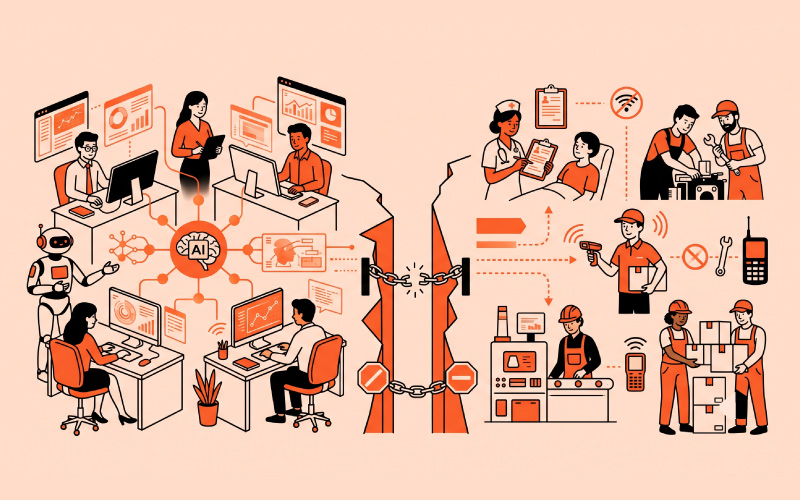
Enterprise AI adoption has grown rapidly, but it has largely bypassed frontline and deskless employees, the 2.7 billion people who make up 80% of the global workforce. While leaders and desk-based employees use generative AI tools daily, deskless staff remain locked out due to a lack of access, device infrastructure, and AI tools designed for their actual workflows.

Introduction
Enterprise AI rollouts have, almost without exception, started at the desk copilots for email, AI assistants for analysts, and automation for knowledge workers. Meanwhile, the people running warehouse floors, hospital wards, retail counters, and field operations are still waiting. This blog looks at why that gap exists, what it’s costing organisations, and what closing it actually requires.

Why Enterprise AI Has Bypassed Frontline Workers
Most enterprise AI tools were built for people who sit at a desk, have a laptop, and work in predictable digital environments, which rules out the majority of the global workforce by design, not by accident.
The reasons deskless employees have been left behind aren’t really about willingness to adopt AI. They’re structural:
- Device mismatch: Most enterprise AI platforms are built for desktop or laptop environments, not the shared devices, handhelds, or no-device-at-all reality of frontline roles
- Workflow misalignment: A warehouse picker or nurse doesn’t have time to open a chat window and type a prompt mid-shift; the interaction model wasn’t designed for hands-on, time-pressured work
- Connectivity gaps: Many frontline environments have inconsistent or no reliable internet access, ruling out cloud-dependent AI tools
- Procurement blind spots: Enterprise software budgets are typically shaped by the people closest to the buying decision, who are usually desk-based themselves
The result is an enterprise AI assistant ecosystem that was never actually built with the majority of the workforce in mind.

The Real Cost of Leaving Frontline Workers Out of Enterprise AI
Excluding deskless staff from enterprise AI isn’t a fairness issue alone; it’s a productivity and retention problem with a measurable price tag attached.
The cost shows up in a few clear places:
- Disengagement: Gallup reports that 85% of employees worldwide are not engaged or are actively disengaged at work, and estimates this drains the global economy roughly $8.9 trillion a year in lost productivity (getflip.com).
- Turnover: Frontline roles in retail and hospitality see annual turnover rates exceeding 100% in some segments, driven partly by feeling under-equipped and under-supported.
- The engagement payoff is real: Gallup’s own meta-analysis shows highly engaged teams are roughly 18% more productive than disengaged ones.
- A widening skills gap: As desk-based roles get faster and smarter with AI, frontline roles risk falling further behind in both efficiency and perceived value within the organization.
When deskless employees are excluded from the AI conversation, the gap doesn’t stay flat; it compounds every quarter that desk-based teams keep accelerating, and frontline teams don’t.

What Frontline Workers Actually Need From Enterprise AI
The fix isn’t shrinking a desk-based AI tool down to fit a phone screen; deskless employees need AI built around how they actually move through a shift.
Effective enterprise AI for deskless teams looks fundamentally different from what works for office-based staff. It needs to be:
- Embedded in the workflow, not a separate app to remember to open
- Voice or visual-first, since typing isn’t always practical mid-task
- Available offline or in low-connectivity environments, with sync-when-available functionality
- Task-specific, solving one clear problem well rather than offering a general-purpose chat interface
- Fast to learn, since frontline teams often have high turnover and limited onboarding time
The World Economic Forum frames this clearly: for frontline AI to deliver on its promise, safety, transparency, and human oversight need to be built in from the start, not retrofitted after deployment (weforum.org).
This is also where training and enablement intersect with AI design. An enterprise AI assistant is only as useful as the content and guidance it’s built on, and for frontline roles, that often means converting dense SOPs, compliance material, and safety procedures into formats people can actually use mid-shift, not documents that stay unread in a shared drive.

How Enterprise AI Platforms Can Close the Frontline Gap
Closing the silicon ceiling requires intentional design choices, not just rolling out the same AI tools used at headquarters to a frontline audience.
Organisations serious about closing this gap are taking a few consistent steps:
1. Start with the workflow, not the technology: Map what a frontline worker’s day actually looks like before choosing a tool. The AI should fit into existing tasks, not add a new one.
2. Prioritise mobile-first, low-bandwidth design: Enterprise AI platforms built for frontline use need to function reliably on shared devices and patchy connectivity. This isn’t optional infrastructure; it’s foundational.
3. Translate policy and training content into usable formats: Static documents don’t help someone mid-shift. Converting SOPs and compliance material into short, structured, mobile-friendly learning content makes the difference between information that’s available and information that’s actually used.
4. Involve deskless employees in tool selection: The procurement gap exists partly because frontline voices are rarely in the room. Including supervisors and workers themselves in evaluating tools surfaces friction points that leadership often misses entirely.
5. Measure adoption, not just deployment: Rolling out a tool isn’t the same as it being used. Track actual engagement and usage patterns among frontline teams, not just licence counts.

What Closing the Enterprise AI Gap Looks Like in Practice
Organisations that succeed here treat frontline AI as a distinct design problem, not a smaller version of what’s already working at headquarters.
The common thread across the data is this: the silicon ceiling isn’t a technology limitation, it’s a design and investment choice. Enterprise AI has been built for the people closest to the budget and the boardroom, not for the 2.7 billion people whose work actually keeps operations running.
That’s slowly starting to shift, and the organisations seeing results aren’t doing something radically different. They’re starting with deskless workflows first, designing tools and content around real shift conditions, and treating frontline enablement as seriously as they treat desk-based productivity.
One of the most practical starting points is content. Most frontline knowledge still lives in dense SOPs, compliance documents, and policy manuals that nobody reads mid-shift. BrinX.ai was built to solve exactly this gap: an AI authoring platform that converts SOPs, policies, and training material into structured, mobile-ready, LMS-deployable courses in minutes instead of weeks. It’s enterprise-grade by design, with end-to-end encryption, no data retention, and GDPR-compliant security, so frontline content can be created at scale without compromising on governance or quality.
If your organisation is rolling out enterprise AI without asking how it serves the frontline, the gap isn’t closing on its own; it’s widening every quarter. Desk-based teams move faster while frontline teams wait.
Contact us to see how BrinX.ai can turn your existing SOPs and training content into AI-ready, frontline-friendly learning your deskless teams will actually use.

Frequently Asked Questions
What is enterprise AI?
Enterprise AI refers to artificial intelligence tools and platforms deployed across an organisation to improve productivity, decision-making, and workflow efficiency. It includes AI assistants, automation tools, and analytics platforms, though adoption has historically concentrated among desk-based teams rather than deskless employees.
Why are frontline workers left out of enterprise AI?
Deskless employees are often excluded because most enterprise AI tools are designed for desktop environments, assume reliable internet access, and weren't built around fast-paced, hands-on workflows. Procurement decisions are also typically made by desk-based teams, leaving frontline needs underrepresented.
What is an enterprise AI assistant?
An enterprise AI assistant is an AI-powered tool that helps employees complete tasks, access information, or automate parts of their workflow. For deskless use, effective assistants need to be mobile-first, voice or visual-friendly, and functional in low-connectivity environments.
How can enterprise AI platforms better support deskless staff?
Enterprise AI platforms can better support deskless teams by designing for mobile and offline use, embedding AI directly into existing workflows, and converting training content into accessible, bite-sized formats. Involving frontline staff in tool selection also significantly improves real-world adoption.
What is the business impact of excluding deskless employees from AI tools?
Excluding deskless employees from AI tools contributes to disengagement, higher turnover, and a widening productivity gap between desk-based and frontline teams. Gallup estimates that low engagement costs the global economy roughly $8.9 trillion annually in lost productivity.