

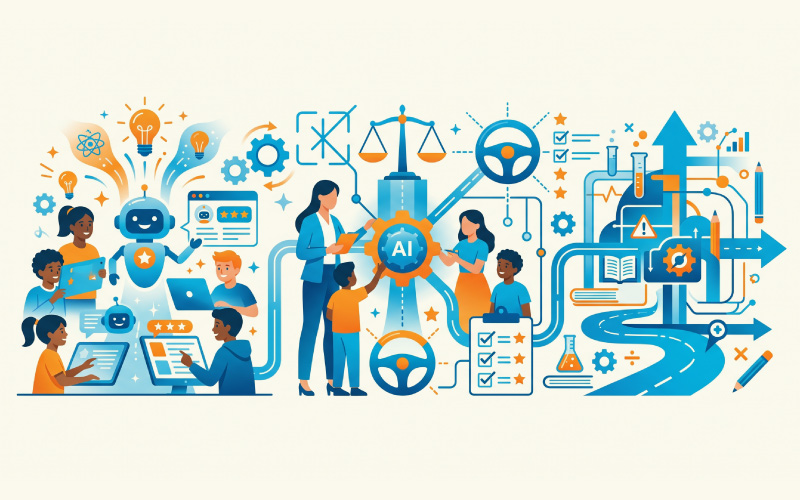
AI learning assistants in K-12 education are tools that use artificial intelligence to personalise instruction, provide real-time feedback, and support both students and teachers. When implemented responsibly with clear policies on data privacy, bias, and overreliance, they improve learning outcomes and reduce teacher workload. Without those guardrails, they introduce risks that undermine equity and student development.

Introduction
AI is already in classrooms. Not as a future possibility, as a present reality. According to a Gallup survey, 60% of K-12 public school teachers used AI tools during the 2024–2025 school year, with 32% using them at least weekly.
That adoption is accelerating fast. 85% of teachers and 86% of students used AI in the 2024–25 school year, and the Center for Democracy and Technology flagged a pointed warning alongside it: rising use is directly connected to rising risk.
This is the tension every school leader needs to sit with. AI learning assistants in K-12 education offer real, measurable benefits and real risks around privacy, bias, and what happens to student thinking when an AI is always ready to do it for them.This blog explores both and what responsible implementation actually looks like.

What Are AI Learning Assistants and How Are They Used in K-12 Education?
AI learning assistants are software tools that use artificial intelligence to support students and teachers, personalising content, automating feedback, and helping educators manage the administrative load that eats into teaching time.
In practice, AI learning assistants in K-12 education show up in several forms:
- Intelligent tutoring systems that adapt content difficulty based on student performance in real time
- Writing and feedback tools that assess student work and return comments without waiting for a teacher to mark a full set
- AI learning path generators that map individual learning journeys based on prior knowledge and assessments
- Conversational AI assistants that answer student questions, clarify concepts, and guide independent study
- Administrative tools that help teachers with lesson planning, rubric creation, and progress reporting
The World Economic Forum reports that 71% of teachers and 65% of students view AI assistants as essential for learning and workforce preparation. That’s a strong signal, but essential doesn’t automatically mean ready for every school context without the right safeguards.

Why Schools Are Turning to AI Learning Assistants for Personalized Learning
The core appeal of AI in K-12 is straightforward: every student learns differently, and no single teacher can personalise instruction for 30 students at once. AI changes that ratio.
Here’s what’s driving adoption:
- Teacher time savings: Teachers using AI tools save an average of six hours a week, almost a full school day.
- Personalised support at scale: An AI learning assistant adapts explanations, pacing, and exercises to each student simultaneously.
- Immediate feedback: Students don’t wait days for marked work; responses arrive in the moment, when learning is still active.
- Early intervention: Adaptive tools identify patterns of struggle and flag at-risk students before disengagement sets in.
- Reduced admin: 52% of educators use AI for brainstorming and content creation; others use it for lesson planning and grading.
For schools managing growing enrolments and teacher shortages, the case for K-12 education online tools powered by AI is compelling.

The Benefits and Risks of AI Learning Assistants in K-12 Education
AI learning assistants offer significant advantages, but the same 2025 data that highlights benefits comes with a consistent warning: adoption without oversight introduces risks schools can’t afford to ignore.
| Benefits | Risks |
|---|---|
| Personalised learning at scale | Student overreliance on AI for answers |
| Real-time, targeted feedback | Algorithmic bias replicates existing inequities |
| Time savings for teachers | Data privacy risks for minors |
| Early identification of at-risk students | Reduced critical thinking and independent effort |
| Consistent content delivery | Lack of transparency in AI decision-making |
Research published in ScienceDirect warns that repeated use of an AI assistant was associated with reduced functional connectivity in brain networks linked to higher-order cognition. A “readymade mentality” where learners use AI to get finished answers without engaging with underlying concepts is a real and growing concern flagged by both teachers and students.
On equity: without oversight, AI-driven assessment tools can inadvertently amplify bias present in training data, risking unequal treatment of students. These aren’t reasons to avoid AI; they’re reasons to implement it carefully.

How Schools Can Assess AI Readiness Before Implementation
Before adopting any AI tool, schools need an honest audit of their readiness infrastructure, data quality, staff capacity, and policy, not just the technology features on offer.
A readiness check for AI learning assistants in K-12 education should cover:
Infrastructure
- Reliable internet access for all students?
- Existing LMS compatible with AI integration?
Data governance
- Is student data protected under applicable regulations FERPA, DPDP Act in India, GDPR in Europe?
- Who owns the data collected, and how long is it retained?
Staff capacity
- Do teachers understand how the tools work, including their limitations?
- Has training covered bias awareness, data privacy, and how to critically question AI outputs?
Policy
- Is there an AI use policy distinguishing between AI-assisted learning and academic dishonesty?
- As of early 2025, 28 states have issued K-12 AI guidance schools without a policy framework are taking on unnecessary risk.

A Framework for Responsible AI Implementation in K-12 Education
Responsible implementation isn’t one decision; it’s a layered process involving policy, training, piloting, and continuous review.
1. Start with policy, not platforms:
Define what AI tools can and cannot be used for, and by whom. Separate high-stakes uses (assessment, IEP decisions, educator evaluation) from low-stakes ones (lesson planning, practice exercises).
2. Pilot in one subject or year group:
Don’t deploy school-wide at once. Pick a controlled context, measure outcomes over one term, and use that data to inform wider rollout.
3. Train teachers before students:
Educators need to understand the tool and its limitations before it enters any classroom. AI literacy for teachers is non-negotiable.
4. Build in human oversight:
AI should flag, suggest, and support, not decide. The Southern Regional Education Board is clear: AI should be a partner, not a replacement, for teachers (sreb.org).
5. Review continuously:
Set a review cycle at least once per semester to assess whether the tool is delivering intended outcomes and whether equity or privacy concerns have emerged.

Which Metrics Should Schools Track to Measure AI Impact?
If schools can’t measure the impact of AI tools, they can’t justify the investment or catch problems before they compound.
| Metric Type | What to Measure |
|---|---|
| Learning outcomes | Assessment scores, completion rates, knowledge retention at 30/60 days |
| Engagement | Time on task, lesson completion, help-seeking behaviour |
| Equity | Performance gaps across student subgroups |
| Teacher experience | Time saved, confidence, perceived impact on instruction |
| Dependency indicators | Rate of independent vs. AI-assisted task completion over time |
That last row matters most. If students are completing more work but relying entirely on AI to do it, completion data looks good while learning outcomes quietly deteriorate. Measuring independence alongside output is what separates responsible monitoring from surface-level reporting.

Questions Learning Leaders Should Ask Before Choosing AI Tools
The vendor pitch focuses on what the tool can do. The right questions focus on what it does with student data and who bears responsibility when something goes wrong.
Before committing to any AI learning assistant, ask:
- Transparency: Can the vendor explain how the AI makes decisions? Is it auditable?
- Data ownership: Who owns student-generated data? Can it be deleted?
- Bias testing: Has the tool been tested for bias across different student demographics?
- Compliance: Does it meet child data protection laws in your jurisdiction?
- Exit strategy: If the school discontinues the tool, what happens to student data?
These aren’t IT questions alone; school leaders, learning designers, and parent communities should all be part of answering them.

What Responsible AI Adoption Looks Like in K-12 Education
Responsible adoption isn’t cautious adoption; it’s informed adoption. Schools that get this right move deliberately, with transparency at every step.
Schools getting AI learning assistants in K-12 education share a few things in common. They involve teachers in the selection process, not just administrators. They communicate openly with parents. They build review cycles from the start. And they treat AI as a tool to enhance teaching, not substitute it.
At MITR Learning & Media, we work with K-12 schools across India, APAC, and international curricula contexts to design AI-integrated learning experiences grounded in pedagogy first, technology second. Through BrinX.ai, our AI authoring platform, schools can convert existing SOPs, lesson content, and documentation into structured, ready-to-deploy digital learning in a fraction of the usual time. And through PersonaTrain.ai, educators and staff can practise high-stakes conversations such as parent communication, classroom management, and safeguarding protocols with AI personas that adapt and coach in real time, before those conversations happen for real. From building AI learning path frameworks to training educators to use tools critically, we help schools move from curiosity to capability without cutting corners on student safety, equity, and genuine outcomes.

FAQs: Responsible AI in K-12 Education
What are AI learning assistants in K-12 education?
AI learning assistants in K-12 education use artificial intelligence to personalise instruction, deliver instant feedback, and support teachers with planning and admin. They range from intelligent tutoring systems to adaptive platforms that adjust content based on each student's individual performance and learning needs.
What are the benefits of AI learning assistants for students?
They personalise learning, identify at-risk students early, and deliver immediate feedback. Teachers using AI tools save an average of six hours weekly, which goes back to teaching, mentoring, and higher-quality interaction with students who need it most.
What are the risks of using AI learning assistants with children?
Key risks include student overreliance, algorithmic bias disadvantaging certain groups, data privacy concerns for minors, and reduced independent thinking. Without clear policies and teacher oversight, these risks quietly undermine the very learning outcomes AI is meant to improve.
How should schools implement AI tools responsibly in K-12?
Start with a policy framework, audit data governance, train teachers first, pilot in a controlled context, and build regular review cycles. Responsible implementation keeps human oversight central AI supports educators, it doesn't replace them.
How do AI learning assistants support personalised learning in K-12 schools?
They adapt content difficulty, pacing, and feedback to each student's performance data. Struggling students get extra scaffolding, advanced students move ahead without waiting, and teachers get real-time visibility into individual progress.
What questions should schools ask before choosing an AI learning tool?
Ask about data ownership, bias testing, child data protection compliance, transparency of AI decision-making, error correction, and what happens to student data if the tool is discontinued. These are institutional questions, not just ones for IT teams.