

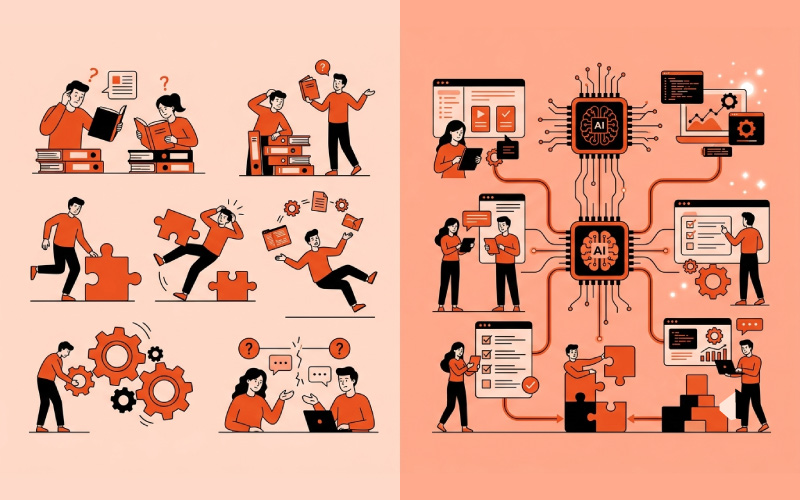
SOP training often fails at execution because it’s delivered once, doesn’t reflect real working conditions, and falls out of date as procedures change. AI-powered training solutions like BrinX.ai close this gap by converting SOPs into interactive, role-specific training that stays aligned with current procedures, reducing training drift and supporting consistent SOP adherence across sites and teams.

Introduction
A perfectly written SOP isn’t the same as a correctly followed SOP. Most organisations spend years improving documentation; fewer ask why employees don’t follow it once it’s written. That’s the execution gap.
Most SOPs fail at the point of use, not on the page. The document is fine. The training was a one-time event. By the time anyone notices the gap, something has usually already gone wrong: an audit finding, a near-miss, a complaint that traces back to a procedure everyone assumed was being followed.

Why Do Employees Fail to Follow SOPs Even When Procedures Are Documented?
Employees fail to follow SOPs mainly because training happens once, usually during onboarding, while the SOP itself is rarely revisited. Months later, they rely on memory rather than the document, and memory drifts in ways nobody notices until it shows up as a deviation.
Studies on the Ebbinghaus Forgetting Curve suggest that learners can forget up to 70% of newly learned information within 24 hours without reinforcement, making one-time SOP training a fragile foundation for long-term adherence.
The SOP itself often doesn’t help either. A forty-page PDF on a shared drive is technically available, but nobody opens it mid-shift. So people default to memory, and memory drifts.
There’s also a content problem. Training usually covers the SOP under ideal conditions. It rarely covers what to do when a customer is upset, equipment behaves oddly, or two procedures seem to conflict.
None of this is about carelessness. It’s about SOP adherence depending on conditions that one-time training simply doesn’t create.

What Causes SOP Execution Failures in Enterprise Operations?
SOP execution failures are mostly caused by a mismatch between how procedures are written and how work actually happens. SOPs assume full attention and unhurried time, while real shifts involve interruptions, competing priorities, and edge cases the document never anticipated.
SOPs also get updated on a schedule: quarterly, annually, after an audit. But conditions on the ground change faster. An employee trained once may be following a version of the procedure that’s quietly out of date.
Over time, this produces “workaround culture.” Not disregard, just shortcuts that formed because the official procedure didn’t survive contact with real work.

The SOP Execution Gap: Why Documented Processes Break Down at the Point of Use
The SOP execution gap exists because the procedure isn’t present at the moment it’s actually needed. A SOP can be accurate and fully approved, and still fail in practice because at the moment that matters, the employee has no easy way to access or verify it.
At that moment, three things are usually missing. Context: Does this SOP even apply to this exact situation? Am I confident I’m remembering this right? Access: Where would I even check, quickly, without stopping work?
Traditional SOP training answers all three weeks or months too early in a classroom, long before the moment it’s needed.
That’s why organisations with great documentation and high completion rates still see compliance failures. Completion was never the same as capability.

What Do SOP Compliance Failures Cost Organisations?
SOP compliance failures cost organisations far more than the immediate incident; the costs stack across regulatory, operational, quality, and reputational lines, and tend to compound rather than stay isolated. The pattern repeats because the underlying training gap is rarely addressed.
In fact, research by the Ponemon Institute found that the average cost of non-compliance is approximately 2.7 times higher than the cost of maintaining compliance programs, highlighting just how expensive execution failures can become.
SOP compliance, in practice, doesn’t mean “was training completed.” It’s “did the right thing happen every time, no matter who was doing it.” When that breaks down, here’s where it shows up:
- Regulatory cost: especially in pharma, BFSI, healthcare, and manufacturing, where audit findings on non-adherence can mean fines or licence issues.
- Quality and safety cost: incidents that trace back to a procedure that existed but wasn’t followed.
- Operational cost: different shifts interpreting the same SOP differently, so errors compound and become hard to trace.
- Reputational cost: customer-facing failures are more visible and damaging than internal deviations.
- Repeated retraining cost: retraining on the same content that didn’t work the first time, without changing format or timing.
The pattern repeats because the underlying gap between SOP training and SOP execution was never actually closed.

How Are AI and New Regulations Changing Enterprise SOP Expectations?
Two shifts are happening together, and they reinforce each other. Regulators now expect training to stay aligned with current SOP versions, not just to have happened once, while AI makes it practical to actually keep training that current, at scale, across every procedure.
First, regulators expect more. It’s no longer enough that SOPs exist and training was completed. Auditors now expect training content to match the current SOP version and a defensible link between training and real behaviour.
Second, AI makes a different kind of training possible. AI powered training solutions can convert SOP documents into structured, interactive content quickly and keep it aligned every time the SOP changes. According to McKinsey, generative AI could significantly accelerate productivity growth in knowledge-intensive work, demonstrating the potential of AI to improve efficiency while reducing manual effort.
This matters because of training drift: SOPs get updated, training material doesn’t, and employees keep training on a version that no longer exists. BrinX.ai addresses this directly: when a SOP changes, training can be regenerated and redeployed in days, not months.

How Can AI Transform Static SOPs Into Intelligent Execution Support?Into Intelligent Execution Support?
AI transforms static SOPs by turning a document that sits still into training that actively responds, converting content into interactive modules, surfacing targeted refreshers, staying current as procedures change, and adapting by role, language, or site at scale.
A static SOP waits for someone to open it. BrinX.ai turns that same content into something built around the moments employees actually need help in a few specific ways:
- From document to interactive learning: SOPs become structured modules with scenarios reflecting real working conditions, not idealised ones.
- From one-time training to ongoing reinforcement: BrinX.ai can help identify which parts of an SOP are most often misapplied, and surface short refreshers on exactly those points.
- From static to always-current: when a SOP is revised, training content can be regenerated quickly, cutting the training drift that drives most execution gaps.
- From generic to role-specific: the same content can be adapted by role, language, or site, at a scale that was previously too costly.
None of this replaces good instructional design. What changes is the speed of keeping training aligned with the SOP, which is where most execution gaps start.

How Can Enterprises Identify SOP Execution Gaps Before Compliance Failures Occur?
Enterprises can identify SOP execution gaps early by watching for divergence between training data and performance data before an audit, incident, or complaint forces the issue. The clearest signals show up when completion rates and real-world outcomes start telling different stories.
Most organisations find execution gaps reactively, through an audit, an incident, or a complaint. By then, the gap already caused a failure. A proactive approach looks for divergence between training data and performance data:
| Signal | What It Often Means |
|---|---|
| High completion, low scores on specific topics | Content isn’t landing, not an effort issue |
| Long gap since last training refresh vs. SOP update | Training drift likely; an outdated version is still being used |
| Same SOP, different results across shifts or sites | Execution gap, not a documentation gap |
| Repeated “how do I handle this” questions | A context gap the SOP doesn’t cover |
| Near-misses with no formal follow-up | Often the earliest warning sign |
None of these signals is dramatic alone. The organisations that close the gap fastest are the ones watching for them continuously, not waiting for the moment they become impossible to ignore.
This kind of monitoring used to require significant manual effort, pulling data from multiple systems, comparing it by hand, and hoping someone noticed the pattern in time. AI powered compliance training changes that equation. When training content, assessment data, and SOP versions all sit within the same system, spotting divergence becomes far more straightforward.
For enterprises managing hundreds of SOPs across multiple sites, this shift matters more than it might first appear. It’s the difference between discovering an execution gap during a routine review and discovering it during a regulatory audit two very different conversations to be having.

Key Takeaways
- SOP execution failures are rarely about disregard. They’re about a mismatch between how SOPs are written and how work actually happens.
- The SOP execution gap is a point-of-use problem: context, confidence, and access go missing exactly when employees need them.
- SOP compliance failures carry costs across regulatory, operational, quality, and reputational lines, and repeated retraining rarely fixes the root cause.
- Regulators now expect training to stay aligned with current SOPs, not just to have happened once.
- AI-powered training solutions can turn static SOPs into role-specific, continuously updated training, directly tackling training drift.
- Watching for early signals—such as assessment gaps, training-update lag, and workaround patterns—helps enterprises catch execution gaps before they become compliance failures.

Frequently Asked Questions About AI Learning Agents
What is SOP training?
SOP training teaches employees the procedures relevant to their role, what to do, in what order, and under what conditions. Good SOP training builds judgment to apply the procedure correctly in real conditions, not just ideal ones.
What does SOP compliance mean?
SOP compliance meaning, in practice, means whether employees consistently follow documented procedures, not just whether they completed training on them. It requires the procedure to be current, the training to reflect it, and employees to apply it correctly at the point of use.
Why do SOPs fail even when training is completed?
Because completion measures attendance, not capability. Training delivered once, without reinforcement or alignment to the current SOP version, leaves a gap between what employees were taught and what they need to do months later.
How does AI help with SOP training and compliance?
AI powered training solutions like BrinX.ai convert SOP documents into interactive, role-specific training quickly and regenerate it when SOPs are updated. This reduces training drift and supports more consistent SOP adherence across sites and teams.
What is the difference between SOP adherence and SOP execution?
SOP adherence is whether employees follow the procedure as documented. SOP execution is the broader outcome of whether the intended result happens, including in situations the SOP didn't anticipate. Strong adherence supports good execution, but gaps can still exist.