
Institutional knowledge loss is not a future risk. It is happening right now, inside organizations that believe their documentation is adequate, their mentorship programs are sufficient, and their succession planning is in good shape. The data tells a different story, and so does the cost of getting this wrong.
The retirement wave hitting enterprises across every major industry is unlike anything previous generations of HR and L&D leaders have had to manage. We are not talking about gradual workforce attrition. This is a large-scale loss of institutional expertise. Most organizations are far less prepared for it than they realize.
The Retirement Wave Is Creating a Hidden Institutional Knowledge Crisis
Approximately 10,000 Baby Boomers reach retirement age each day in the United States, according to the Pew Research Center. This workforce transition is accelerating the loss of institutional expertise across industries. Many organizations remain unprepared for the resulting knowledge retention challenges.
72% of managers are not confident they can retain expertise lost from retiring workers (Workplace Intelligence, 2025)
What makes this crisis largely hidden is that most organizations do not feel it acutely until a critical role goes vacant. The engineer who knew why a particular system was configured a certain way has already left. The compliance lead who understood the practical intent behind a regulation, not just its text, is gone. The problem reveals itself only after the expertise has departed.

Why Most Organizations Underestimate the Risk of Institutional Knowledge Loss
The SOP illusion
There is a common assumption in enterprise organizations that documented processes equal preserved knowledge. If it is written down in an SOP, the logic goes, then the knowledge is safe. In reality, this creates a false sense of security and often delays meaningful knowledge transfer efforts.
SOPs capture what an expert does. They rarely capture why. They document steps, but not the judgment behind them. That knowledge lives with the expert, not in the documentation.
Documentation is not expertise
Research suggests that documentation captures only a small portion of what employees know. Much of their expertise exists as tacit knowledge, including practical judgment, context, and lessons learned through experience.
The difference is simple. Documentation explains what to do. Expertise helps people understand when, why, and how to do it.
Troubleshooting expertise that no SOP can capture
Experienced employees can quickly understand what is causing a problem and where to focus their efforts to solve it. This is not instinct. It is experience compressed into action.
A less experienced employee may eventually reach the same conclusion using the same documented process. The difference is the time, cost, and risk involved in getting there.
The judgment behind high-stakes decisions
Senior employees make decisions shaped by years of experience. They have encountered situations that never appear in formal documentation.
Their value lies not only in what they know. It also lies in how they apply that knowledge under pressure. When that expertise leaves, organizations often discover that documented processes cannot replace experienced judgment.
Relationship intelligence and organizational memory
Customer relationships built over years do not transfer with a contact list. Stakeholder trust, client preferences, and informal networks exist in the experience of the employee, not in a CRM system.
The same applies to organizational memory. Understanding why past decisions were made, what approaches failed, and where hidden risks exist often resides with a small group of experienced employees. When they leave, that context frequently leaves with them.

The Business Impact of Institutional Knowledge Loss
Large US companies lose an average of $47 million annually due to inefficient knowledge sharing, according to Panopto’s Workplace Knowledge and Productivity Report.
Much of this loss comes from employees recreating work, searching for information, and making avoidable mistakes.
Revenue and Customer Relationship Risk
Some costs are not easy to quantify. A sales team may lose a key account when an experienced relationship manager retires. The knowledge and trust built over years often leave with that person.
Increased Compliance and Operational Exposure
Institutional knowledge loss can also create operational and compliance risks. A compliance team may misinterpret a regulation because the employee who understood its history and practical application is no longer available. Operations teams may revert to trial-and-error problem-solving when experienced troubleshooters leave the organization.
These are not theoretical risks. They are business continuity failures that organizations often attribute to other causes rather than recognizing as knowledge loss.
Rising Workforce Development Costs
The workforce impact is just as significant. New hires replacing experienced employees often take longer to become fully productive. They make more mistakes early on and need more support from managers. This increases onboarding costs and extends the productivity gap after an employee leaves.

Why Traditional Knowledge Transfer Methods Fall Short
Most organizations rely on knowledge retention strategies such as exit interviews, mentorship programs, and knowledge repositories to address retirement risk. Each provides some value. None fully addresses the challenge of preserving expertise at scale.
Exit Interviews Capture Information, Not Expertise
Exit interviews happen too late. They attempt to capture years of experience in a few short conversations after an employee has already decided to retire.
Mentorship Programs Cannot Scale
Mentorship programs can help transfer knowledge. However, they depend on experienced employees having the time to mentor others and on learners staying actively engaged throughout the process.
For organizations facing simultaneous retirements across multiple critical roles, mentorship alone is difficult to scale and standardize.
Knowledge Repositories Become Digital Graveyards
Many organizations rely on SharePoint libraries, wikis, and internal knowledge bases to preserve expertise. Over time, these repositories often become storage systems rather than knowledge systems.
Traditional knowledge repositories and knowledge management software are often not enough to preserve expertise.
Content is uploaded but rarely updated. Search experiences are poor, and adoption rates are frequently lower than expected. Research has shown that employees regularly recreate documents simply because they cannot find information that already exists within the organization.
The Core Problem Remains Unsolved
Traditional approaches focus on storing information. They struggle to capture expertise, judgment, and contextual knowledge. As retirement rates accelerate, organizations need a more scalable way to preserve and transfer institutional intelligence.

A Framework to Identify Institutional Knowledge Risk Before Retirement
The organizations managing this well are not waiting for a retirement announcement to trigger knowledge transfer. They are running proactive risk assessments that identify where exposure is highest and prioritize accordingly. Here is the framework that enterprise L&D and HR leaders are using.
| Identify Critical Roles Which positions, if vacated without knowledge transfer, would cause the most significant operational, commercial, or compliance disruption? This is not the same as seniority. Some mid-level roles hold disproportionate institutional knowledge. | Assess Expertise Concentration Where does critical knowledge sit in a single person, rather than being distributed across a team? Single points of failure represent the highest-priority transfer risk. |
| Evaluate Documentation Maturity For each critical role, what percentage of the role’s knowledge exists in accessible, current documentation? The gap between what is documented and what actually drives performance is the risk profile. | Measure Retirement Exposure Using workforce demographic data, map which critical role holders are within a five-year retirement window. This creates a sequenced transfer priority list tied to real timelines rather than hypothetical risk. |
The output of this exercise is a knowledge risk register: a prioritized view of where the organization is most exposed, which roles need immediate capture investment, and what gaps in documentation need to be closed before the departure window opens.

How AI Captures What Traditional Documentation Misses
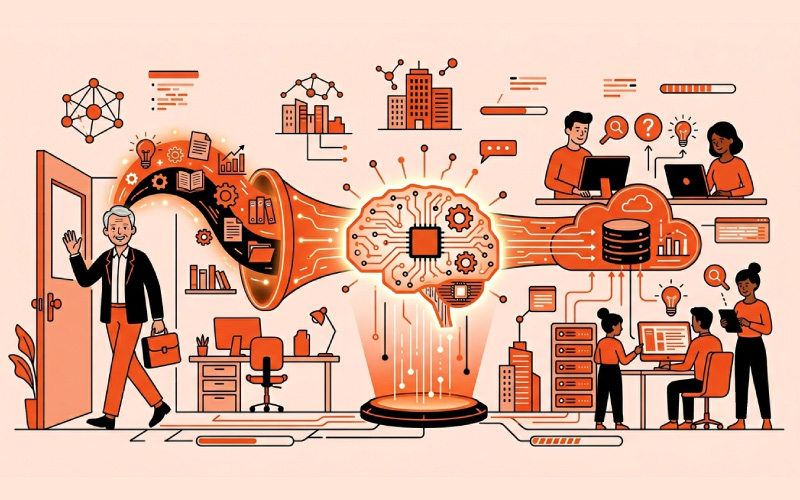
The value of AI knowledge management goes beyond automating documentation. It helps organizations capture and preserve expertise, including the reasoning, context, and judgment that traditional documentation often misses.
01: Capturing reasoning, not just procedure
AI-powered knowledge extraction tools use conversation, interview transcription, and multimodal input to record not just what an expert does, but why. Natural language processing and knowledge graphs build a semantic map that connects decisions to their context, not just their sequence.
02: Mining existing digital artifacts for tacit knowledge
Decades of expertise live in email threads, Jira tickets, meeting recordings, and call transcripts. Generative AI platforms can process these unstructured sources to surface patterns, decisions, and heuristics that were never explicitly documented. The expert’s judgment is often already there, buried in digital breadcrumbs across enterprise systems.
03: Converting conversations into searchable, structured knowledge
Structured interviews help capture expert knowledge before employees retire. Organizations can use technologies such as Retrieval-Augmented Generation (RAG) to make that knowledge easy to search and access. Employees no longer need to dig through folders and documents. They can ask a question and quickly find relevant answers. Those answers are based on expertise that has already been captured and preserved.
04: Turning captured knowledge into learning content
Once expert knowledge is captured, AI authoring tools can convert it into structured, role-specific eLearning. The expert’s decision trees, diagnostic frameworks, and exception-handling logic become interactive learning scenarios and simulations that build the same judgment in the next generation of employees, not just the same procedural knowledge.

From Knowledge Management to Institutional Intelligence
| Traditional Knowledge Management | Institutional Intelligence |
|---|---|
| Stores information | Preserves and structures expertise |
| Requires employees to search for documents | Surfaces expert reasoning in context |
| Human-dependent retrieval and interpretation | Enterprise-scalable and queryable |
| Reactive | Context-aware |
Traditional enterprise knowledge management systems focus on storing information and documentation. Institutional intelligence goes beyond storing information. It makes expertise accessible, usable, and scalable across the enterprise.

What Future-Ready Enterprises Are Doing Differently
The enterprises managing institutional knowledge risk most effectively share four practices that distinguish their approach from the industry average.
- They start knowledge capture programs three to five years before projected retirement dates, not during the departure notice period. The goal is ongoing extraction during active employment, not retrospective capture during exit.
- They treat expertise as a strategic asset with a measurable risk profile, using knowledge risk registers and workforce planning data to prioritize where capture investment is deployed first.
- They build AI-powered knowledge systems that integrate with existing workflows, so that captured expertise surfaces in the tools employees already use rather than in separate repositories nobody visits.
- They align knowledge retention programs directly with workforce planning and succession planning, so that the same demographic data that identifies retirement risk triggers the knowledge capture investment timeline.
- They measure success not by how much has been documented, but by how much the next generation of employees can actually do with what has been captured.

How BrinX.ai Helps Preserve Institutional Intelligence
BrinX.ai helps organizations identify knowledge at risk and transform expert knowledge into searchable, reusable institutional intelligence. Instead of relying on static repositories, organizaations can make expertise accessible across onboarding, workforce development, succession planning, and day-to-day operations.
Organizations are increasingly investing in AI-driven knowledge management solutions to preserve expertise at scale. The goal is not simply to store information. It is to ensure that critical knowledge remains accessible long after experienced employees leave.
As retirement rates continue to rise, AI knowledge management is becoming an important part of enterprise knowledge retention efforts. Organizations that act early are better positioned to preserve expertise, reduce knowledge loss, and support workforce continuity.
Want to explore how BrinX.ai can help your organization identify knowledge at risk and preserve critical expertise before it is lost? Contact our team to learn more.

Frequently Asked Questions
What is institutional knowledge loss?
Institutional knowledge loss occurs when employees leave an organization and take critical expertise, context, relationships, and decision-making knowledge with them.
Why do SOPs fail to preserve expertise?
SOPs document processes but rarely capture judgment, experience, troubleshooting methods, and contextual decision-making.
How can organizations identify knowledge at risk before employees retire?
Organizations can assess role criticality, expertise concentration, documentation maturity, and retirement exposure to identify areas of highest risk.
How does AI help preserve institutional knowledge?
AI captures expertise from conversations, workflows, documents, and expert interactions, making knowledge searchable and reusable across the organization.
What is the difference between knowledge management and institutional intelligence?
Knowledge management focuses on storing information, while institutional intelligence focuses on preserving and applying expertise, judgment, and organizational memory.
How long before retirement should knowledge capture begin?
Organizations should begin knowledge capture several years before anticipated retirements to ensure sufficient time for expertise extraction and validation.