
The current conversation in L&D is asking the wrong question.
It’s not about whether AI will replace eLearning vendors. It’s about what it actually replaces in the way content gets created.
In the debate around AI vs eLearning vendors, the real shift is happening inside enterprise learning content development.
AI will not replace vendors. But it will change how enterprise learning content is produced. And that shift will decide whether your L&D function scales or slows down.

The Real Problem Driving L&D Inefficiency in Enterprise Learning Content
Before looking at what AI changes, it’s important to understand what is already broken. Most enterprise L&D teams are not struggling because vendors are expensive or slow. They are struggling because demand for enterprise learning content is growing faster than their production model can handle.
What the Content Backlog Actually Looks Like at Scale
In most enterprise LMS environments, the pattern is consistent. Outdated compliance modules sit alongside newer ones. Onboarding content exists for roles that no longer exist. Product training reflects versions that are no longer relevant. This is not a content quality issue. It is a scale problem in enterprise learning content development.
This is where AI begins to change the equation, especially in how it can structure learning content faster than manual design processes.
Training Demand Is Outpacing Production, and the Gap Carries Real Business Risk
According to the World Economic Forum’s Future of Jobs Report, a large majority of employers (around 75–85%) plan to invest in reskilling, yet a significant share of workers will still not receive the training they need. This gap is not about intent. It is about production capacity in L&D content production systems.
For enterprises, this leads to three clear risks. Compliance exposure when training is not updated fast enough. Productivity gaps when role changes outpace onboarding. Talent attrition when employees feel development is not keeping up.
The content backlog is the structural root cause. Any serious conversation about AI in enterprise L&D content development needs to start here.

Why "AI vs. eLearning Vendors" Is the Wrong Comparison
The Old Model Was Built for a Different World
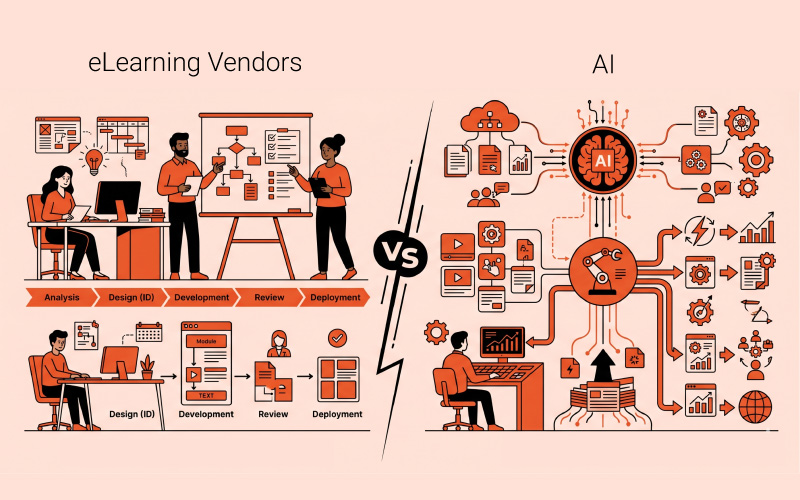
Traditional vendor workflows follow a fixed sequence: scoping, storyboarding, SME reviews, revisions, delivery. This worked when demand was stable and content lasted longer.
It breaks when product cycles shrink, regulations change quickly, and teams need updates at the same time.
The real bottleneck is the sequential nature of the model. Every update restarts the process. Every new requirement becomes a new project. Scale becomes expensive.
The New Model Is an Architecture Decision, Not a Vendor Decision
AI shifts L&D from production to systems thinking. The question is no longer “Which tool should we buy?” It is “How does our AI-powered learning content system operate?”
That system includes LMS integration, modular content, version control, compliance tracking, and localization. It increasingly connects with AI-based LMS content systems and modern AI learning platforms that support continuous content delivery.
This shift is already visible in how AI-assisted instructional design is restructuring enterprise course creation at scale, moving L&D from production to system-led design.

What AI Genuinely Enables in Enterprise Learning Content Production
With the framing corrected, AI’s impact on enterprise L&D becomes clearer, especially in the context of digital learning transformation across large organizations.
Development speed
Cycles that once took months now compress into weeks. AI generates structured first drafts, aligns objectives to Bloom’s Taxonomy, and produces assessments quickly. For teams managing large backlogs, this shift is significant for AI content generation in training.
SME cost efficiency
Subject matter expert time is a major cost driver. Blended SME rates often exceed $150 per hour when you factor in coordination and reviews. AI reduces validation cycles, lowering SME effort per course and improving learning content production efficiency.
Scale across roles and regions
AI enables content creation across multiple roles and domains without increasing headcount or vendor dependency. For global teams, this changes localization economics through learning content automation.
Continuous content refresh
Compliance updates no longer require full production cycles. Content can be updated in days. In industries like financial services, healthcare, and manufacturing, this directly reduces operational risk in enterprise training content systems.
Beyond content generation, there are already multiple practical AI use cases in eLearning that extend into workflow automation, personalization, and performance support.

What Enterprises Lose When They Replace eLearning Vendors with AI Entirely
This is the part most conversations avoid. The goal is not to reject AI, but to understand what breaks when it runs without the right controls in AI-driven instructional design.
Instructional Depth and the Quality Drift Problem
AI-generated content tends to move toward generic output without expert oversight. The shift is gradual, which makes it easy to miss.
A draft looks acceptable. It gets approved because it covers the material. That becomes the new baseline. Repeat this across multiple courses, and you end up with content that checks learning objectives but does little to change behavior in enterprise learning programs.
Elements like spaced practice, scenario design, and learning flow still require judgment. Without that, content may look complete but deliver limited impact. Most teams only notice this when completion rates hold steady, but performance does not improve.
Contextual Quality and Business Alignment
AI is efficient at structuring content. Where it falls short is context.
It cannot fully interpret a regulatory change within your business environment. It cannot design scenarios that reflect how your teams actually work. It also struggles to separate what SMEs say from what learners actually need to understand.
Instructional designers fill this gap. Their role shifts from content creation to design quality, alignment, and governance in enterprise learning content strategy.
Learner Outcomes vs. Learner Completion
Completion rates are a production metric. Behavior change is a learning metric.
AI-generated content often leans toward speed and completion rather than impact in AI-based training content development. Speed of content production does not automatically translate to improved time-to-competency, knowledge retention, or performance improvement.

The Hybrid Model: Why It Runs on Infrastructure, Not Tools
The hybrid AI and vendor model is widely discussed but rarely defined in operational terms. In practice, it looks like this:
AI owns the production layer:
- First-draft generation
- Modular content structuring
- Assessment creation
- Translation and localization
- Version impact detection
- LMS packaging
- Compliance refresh cycles
Human expertise owns the architecture layer:
- Learning architecture and pathways
- Pedagogical strategy
- Scenario design
- SME validation
- Compliance governance
- Behavioral change design
- Contextual quality review
This is a sequenced model of AI and instructional design collaboration.
AI accelerates production. Human expertise governs design and quality.
As AI capabilities improve, the production layer becomes faster. The governance layer does not shrink. It becomes more critical. Faster content without strong governance leads to faster quality decline.
The organizations that succeed will not be those spending more on content. They will be those that can:
- Convert knowledge into learning quickly
- Maintain consistency across scale
- Enforce quality through strong governance
That capability is built at the infrastructure level, not the tool level.
Want to go deeper into how enterprise L&D is shifting from courses to capability systems?
Explore The Capability Transformation: Bonding Courses to Skills and Building Capabilities to understand how learning architecture, AI, and business outcomes connect at scale.

AI in L&D: Three Signs Your Content Model Is Breaking
If your L&D operation shows any of the following patterns, the issue is your learning content operating model.
1. Your content backlog keeps growing
Your team cannot clear demand as fast as it is created. This signals a structural gap between production capacity and training needs. Adding headcount or budget to the same model will not fix it.
2. Your compliance training is over 18 months old in fast-changing areas
This is not a quality issue. It is a throughput issue. Your update cycles are slower than the pace of regulatory change.
3. Your localization timelines stretch across quarters
Global teams wait months for training that headquarters deploys in days. This indicates a structural bottleneck in how content is produced and distributed.

Frequently Asked Questions
Will AI replace eLearning vendors in enterprise training?
No. AI replaces the manual, slow, and high-cost production workflows inside enterprise content development. Vendors who provide instructional design expertise, learning architecture, and behavioral change strategy remain essential. What changes is the ratio of AI-accelerated production work to human strategic design work.
What is the biggest risk of replacing eLearning vendors with AI?
Instructional depth and contextual quality. AI-generated content drifts toward generic, passive consumption over time without expert human review. Pedagogical scaffolding, scenario realism, and behavioral design require instructional judgment that AI cannot replicate at enterprise quality thresholds.
What is a hybrid AI and eLearning vendor model?
A hybrid model uses AI to handle high-volume production tasks including first drafts, modular structuring, localization, assessments, and version updates, while expert instructional designers manage learning architecture, pedagogical strategy, compliance governance, and contextual quality review.
What does 'infrastructure-first' mean in enterprise L&D?
Infrastructure-first means building the systems that govern how content is produced, managed, updated, and governed before selecting AI tools or vendors. This includes LMS integration, content taxonomy, version control, governance frameworks, and localization pipelines. Outcomes depend on the infrastructure layer, not the specific AI tool or vendor selected.
What Enterprises That Get This Right Will Look Like in 2027
The L&D teams that lead will not be the ones spending more. They will be the ones building stronger content systems.
AI will remove production friction. Vendors and instructional designers will shift toward design, governance, and quality.
Enterprises that invest in this infrastructure now will run L&D at the speed of business change.
Platforms like BrinX.ai enable this shift by accelerating production while keeping governance intact in AI-powered enterprise learning content development.
The question is not AI vs vendors. It is whether your model makes both work together.The question is not AI vs vendors. It is whether your model makes both work together.
Want to see how this applies to your L&D content system? Explore BrinX.ai or book a walkthrough.