
Most organizations have already invested in AI in HR functions. Yet the impact on workforce capability remains unclear. Teams can see where skills are falling short. But acting on that insight at the right time remains difficult.
Workforce decisions still rely on outdated data, which slows things down and often misses current business priorities. Learning teams respond after problems appear. Programs reflect past demand instead of preparing teams for future needs.
AI tools are in place, but they rarely work together. This disconnect slows execution and limits business impact. This is where AI in HR fails to deliver real outcomes.
Workforce planning fails when data, learning, and execution do not align. The issue is not AI adoption, but how effectively organizations use it across functions.
AI in HR Adoption and Workforce Planning Trends
How Widely Is AI Used in HR in 2026?
AI adoption in HR has reached about 43% across core processes. Most organizations are now moving beyond automation. They are using AI to support decisions and scale it across functions.
This shows a shift toward enterprise-wide deployment. Leaders now expect artificial intelligence in human resource management to support better decisions. It is no longer limited to automating routine work.
This also reflects how AI in HR is evolving from isolated use cases to a core part of enterprise strategy.
How Does AI Improve Workforce Planning and Skills Gap Analysis?
AI in HR is changing how organizations approach workforce planning. Many now use it to improve forecasting accuracy and identify talent needs earlier.
This allows teams to respond before gaps affect performance. It reduces reliance on reactive hiring and supports AI talent acquisition strategies.
However, better predictions only create value when they lead to action. Data alone is not enough, and this is a key limitation many teams face with AI in HR today.
What Is AI-Driven Workforce Planning?
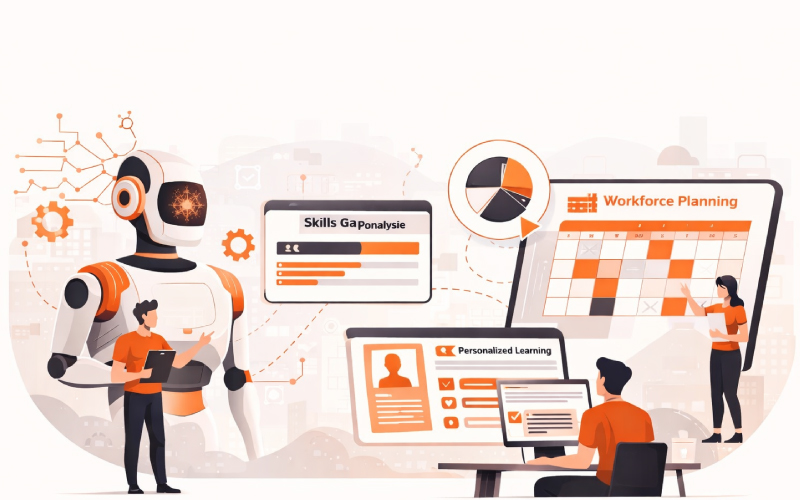
AI-driven workforce planning uses data and predictive models to anticipate talent needs. It reflects how artificial intelligence in HR is evolving beyond automation. It looks at skills, performance, and business demand together.
Based on this, organizations decide where to hire through AI in HR recruitment, where to upskill, and how to use existing talent better. The focus shifts from reacting to planning ahead.
Why Skills Intelligence Is Replacing Traditional Workforce Planning
Organizations are moving toward a skills intelligence approach using AI for talent management. Training alone is no longer the focus. Skills now define capability and business performance.
AI in HR enables organizations to treat skills as measurable and dynamic. It connects workforce data with learning systems. This helps guide decisions in real time. At the same time, skill requirements keep changing faster. Traditional planning cycles struggle to keep up.
Skills intelligence is becoming the foundation of modern workforce strategy.

AI in HR Benchmarks: Where Organizations Stand in 2026
Adoption by Company Size
Mid-sized organizations often focus on automation and reporting. Larger enterprises invest more in predictive models supported by AI HR tools. They also invest in integrated systems. Global organizations are moving toward skills intelligence models. These connect planning with execution.
Adoption by Industry
Technology and financial services lead AI adoption. They benefit from a stronger data infrastructure. Manufacturing and healthcare focus on skills forecasting to address talent shortages. Each industry applies AI based on its operational priorities.
From Workforce Planning to Learning Execution
Organizations must translate workforce insights into capability. Learning systems play a central role in closing this gap. They enable targeted development aligned with business priorities.
Personalized learning ensures employees focus on relevant skills. This improves productivity and reduces delays. When workforce planning and learning operate together, impact becomes measurable.
This shift is best understood through a continuous model called the Skills Intelligence Loop. It connects workforce data, learning, and execution.
Organizations begin by capturing workforce data across systems. This creates a clear view of current capabilities. Predictive models then identify future skill gaps.
These insights guide AI in learning interventions. Programs align with projected needs, and employees apply new skills in real roles. Performance data then feeds back into the system.
Over time, this loop improves decision accuracy. It allows organizations to adapt continuously instead of relying on periodic planning cycles. The challenge is not identifying gaps. It is acting on them at the right time.

How BrinX.ai Bridges Workforce Planning and Learning Execution
Most organizations can identify workforce gaps. The challenge is acting on them fast enough. BrinX.ai connects workforce data with learning so teams can act on what they already know. Most systems show where the gaps are, but they don’t help teams move fast enough.
Here, when a skill gap shows up, BrinX.ai links directly to what people need to learn next. Teams don’t have to switch between tools or figure out the next step on their own.
That’s the difference. Planning doesn’t stop at visibility, it actually leads to action that builds capability over time.
Real-Time Skills Intelligence
Organizations get a clearer view of workforce capabilities across roles, instead of piecing it together from different systems. This makes it easier to spot gaps early and plan with more confidence.
AI-Driven Learning Aligned to Workforce Needs
Learning paths adjust based on projected skill requirements. Employees focus on what matters most. This aligns with the role and future demand.
Business Impact
When a gap is identified, AI in learning actions follows immediately. This reduces delays and ensures planning leads to measurable outcomes.
Organizations achieve:
- Faster time-to-competency
- Improved internal mobility
- Reduced hiring dependency
- Higher workforce productivity
These outcomes reflect better alignment between planning and execution.

Financial Impact and Capability Shift
Skill gaps don’t just stay within teams. They slow down execution, which then affects productivity, revenue, and delivery timelines.
In a 5,000-employee organization, even a 20% improvement in time-to-competency can make a noticeable difference. When employees become productive faster, it directly improves output across critical roles.
This is where reskilling starts to matter more than hiring. Developing internal talent usually costs less and helps retain people who already understand the business. This becomes more effective when supported by AI in HR systems that guide capability development.
Capability Area Comparison
Scroll right to read more.
| Capability Area | Reactive Model | Predictive Model |
|---|---|---|
| Skills Visibility | Fragmented | Unified |
| Workforce Planning | Past-based | Predictive |
| Learning Strategy | Generic | Personalized |
| Execution Speed | Delayed | Immediate |
| Business Alignment | Indirect | Direct |
If your organization aligns more with the reactive model, performance will lag behind demand.
What to Consider Before Investing in AI Workforce Planning
HR AI Maturity Model
Most organizations fall into four stages:
- Automation
- Analytics
- Predictive
- Skills Intelligence
Many enterprises are still in the middle stages, where AI and HR are not fully integrated. This creates a gap between insight and action.
Key Capabilities
Scroll right to read more.
| Capability | Why It Matters |
|---|---|
| Forecasting Accuracy | Enables early action |
| Skills Intelligence | Improves visibility |
| Learning Integration | Drives execution |
| Data Interoperability | Prevents silos |
| Governance | Ensures responsible use |
These capabilities should be evaluated together. They should not be viewed in isolation.

Frequently Asked Questions About AI in HR and Workforce Planning
How does AI improve workforce planning?
AI helps predict talent needs and identify skill gaps earlier. This allows organizations to act before problems grow. It reduces reliance on last-minute hiring.
Can AI predict skills gaps accurately?
AI can identify emerging skill gaps by analyzing workforce data and business trends. Accuracy improves when systems integrate data from multiple sources.
How does AI impact employee learning?
AI enables personalized learning aligned with workforce needs. Employees receive relevant training. This improves engagement and accelerates skill development.
What are the risks of AI in HR?
Risks include data privacy concerns, bias, and lack of governance. Organizations need clear policies and oversight to ensure responsible use.
How can organizations implement AI in workforce planning?
Organizations should align AI initiatives with a workforce strategy. They should integrate learning systems and track measurable outcomes. This ensures an impact.
What outcomes can enterprises expect from AI-driven workforce planning?
Enterprises can expect improved planning accuracy, faster skill development, better retention, and reduced hiring costs. These outcomes support stronger workforce performance and execution.
Explore how BrinX.ai can help you turn workforce insights into real execution outcomes. Book a consultation to understand how you can close skill gaps faster and align learning with business outcomes.