
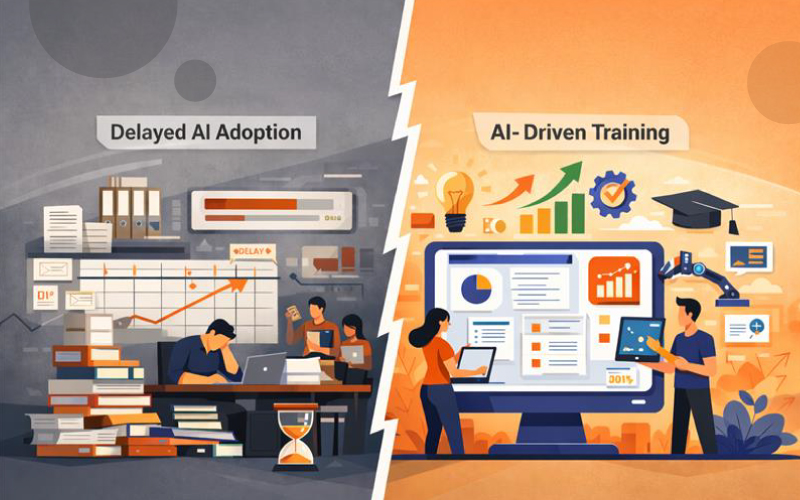
Delaying AI in corporate training can slow workforce capability development. It can also preserve inefficient learning processes. AI-powered learning and AI learning platforms help automate training development. They also improve knowledge access across the organization.
AI learning analytics provide insights into workforce skills and learning performance. Early adoption of enterprise AI can reduce onboarding ramp time. It can also improve training efficiency. AI adoption in corporate learning can strengthen compliance readiness. It can also improve knowledge distribution.
Organizations often remain cautious about AI in corporate training. Concerns typically include governance, cost, and integration challenges. However, postponing adoption can slow the modernization of learning systems.
Learning teams today support continuous workforce development. They must also manage growing volumes of knowledge and compliance training. Without modernization, these demands place pressure on existing learning systems. Many organizations are now exploring modernizing legacy training with AI to address these challenges.
Common operational impacts include:
- Slower workforce skill development
- Longer onboarding ramp times
- Continued reliance on manual training development
- Limited access to institutional knowledge
- Slower response to changing skill requirements
These issues affect how effectively learning teams support workforce performance.

Understanding the Concept of Cost of Delay
In business strategy, the cost of delay refers to the value lost when improvements arrive later than expected. Time has economic value. When organizations delay capability improvements, inefficiencies remain in place.
In the context of AI in corporate training, the cost of delay may include:
- Prolonged manual training development cycles
- Slower workforce capability development
- Delayed knowledge accessibility
Over time these effects accumulate. Organizations miss opportunities to improve productivity and learning efficiency.
In competitive industries, this delay can create operational disadvantages.
Why AI Is Becoming Central to Enterprise Learning
Changing workforce roles demand faster skill development. Employees also need easier access to training and knowledge.
Traditional learning environments still rely on manual processes for:
- Training content development
- Course updates
- Knowledge retrieval
- Compliance documentation
AI learning platforms and AI-powered learning systems automate parts of these activities while improving knowledge accessibility.
Several developments now shape AI in L&D strategies:
- Generative AI in corporate learning
- AI for instructional design
- AI learning analytics for workforce insights
These capabilities support the growing adoption of enterprise AI within learning ecosystems.

Operational Areas Where AI Can Influence Corporate Learning
The impact of AI in corporate training varies by organizational context. However, several operational areas consistently benefit from AI-enabled capabilities.
Learning Content Development
Training content development requires significant time and expertise. Instructional designers often transform documents into structured learning modules.
AI tools now support:
- AI for content creation
- AI course generation
- Automated assessments
- Structured knowledge extraction
These capabilities help learning teams produce training content faster.
Onboarding and Skill Development
AI onboarding training systems support personalized learning pathways. These systems recommend relevant learning resources based on role context.
Employees can access knowledge faster during onboarding. This may shorten the time required to reach productivity.
Compliance Monitoring
Training programs play a critical role in regulated industries. Organizations depend on them for certification tracking and policy awareness.
AI compliance training tools can assist with identifying potential compliance gaps and improving reporting efficiency.

Why Many AI Learning Initiatives Struggle to Deliver Measurable ROI
Organizations are spending more on enterprise AI. But many initiatives show little measurable impact. AI often sits outside workflows or lacks clear business goals.
Common challenges include:
- Limited integration with enterprise systems
- Unclear operational objectives
- Weak data infrastructure
- Insufficient change management
Measuring the Business Impact of AI in Corporate Learning
Organizations evaluate the impact of AI in corporate training through operational indicators.
Typical metrics include:
- Onboarding ramp time
- Training development cycle time
- Knowledge accessibility across teams
- Compliance readiness
- Workforce performance indicators
Many organizations apply established evaluation frameworks.
The Kirkpatrick Model measures learning outcomes across four levels. The Phillips ROI Model extends this framework by calculating the financial return of training initiatives.
These models help organizations evaluate the impact of AI-powered learning. They connect training efficiency, workforce performance, and business outcomes.
A Practical Framework for Adopting AI in Corporate Learning
Organizations often explore AI in corporate training through experimentation. However, successful adoption usually follows a structured implementation approach.
Learning leaders typically introduce enterprise AI in stages.
Step 1 — Identify High-Impact Learning Workflows
Organizations should first identify learning activities that consume significant time.
Examples include:
- Content development
- Onboarding programs
- Compliance training updates
- Knowledge discovery
These areas often benefit most from AI-powered learning tools.
Step 2 — Define Clear Operational Metrics
Before introducing new technologies, organizations should define measurable performance indicators.
Typical metrics include:
- Onboarding ramp time
- Training development cycle time
- Workforce skill development speed
- Compliance readiness
These metrics help organizations measure AI ROI more effectively.
Step 3 — Introduce AI in Targeted Use Cases
Many organizations begin with focused pilots rather than enterprise-wide deployment.
Examples include:
- AI course generation from internal documentation
- AI onboarding training assistance
- Knowledge search and learning recommendations
Targeted pilots allow organizations to evaluate operational impact with lower risk.
Step 4 — Integrate AI with Existing Learning Systems
Successful implementations connect AI capabilities with existing systems.
These often include:
- Learning management systems
- Knowledge repositories
- HR systems
- Collaboration platforms
Integration ensures AI tools support real workflows rather than isolated experiments.
Step 5 — Scale Based on Measurable Results
Once organizations validate operational improvements, they can expand adoption gradually.
Scaling may include:
- broader AI learning analytics deployment
- expanded AI compliance training monitoring
- deeper integration with enterprise knowledge systems
Roll out AI in phases. This keeps risk lower and improves learning efficiency.
FAQ
What is the ROI of AI in corporate learning?
The ROI of AI in corporate learning comes from faster training development and improved workforce productivity. AI tools help teams create training content more quickly. They also support onboarding and compliance programs. When integrated with enterprise learning systems, these capabilities can reduce operational training costs.
How long does it take for AI learning systems to deliver value?
Many organizations see early improvements in three to six months. Results depend on system integration, data readiness, and rollout approach. Early applications, like onboarding support or course creation, often show results first.
What are the risks of delaying AI adoption in corporate learning?
Delaying adoption can preserve inefficiencies in training development and knowledge discovery. Organizations may also struggle to respond quickly to evolving workforce skill requirements and regulatory training needs.
How do organizations measure the impact of AI in learning?
Organizations typically evaluate onboarding ramp time, content development cycles, workforce performance metrics, and compliance readiness. These indicators help connect AI in eLearning initiatives with measurable business outcomes.
What are common starting points for AI adoption in corporate training?
Many organizations begin with use cases such as AI course generation, onboarding support, or knowledge search tools. These applications integrate easily with existing systems and allow organizations to evaluate measurable operational improvements before scaling implementation.
As organizations evaluate how AI can improve learning operations, practical tools are beginning to emerge. Platforms like BrinX.ai can transform internal documents into LMS-ready learning modules while maintaining instructional design standards.
Book a call to see how AI can support your corporate training workflows.