

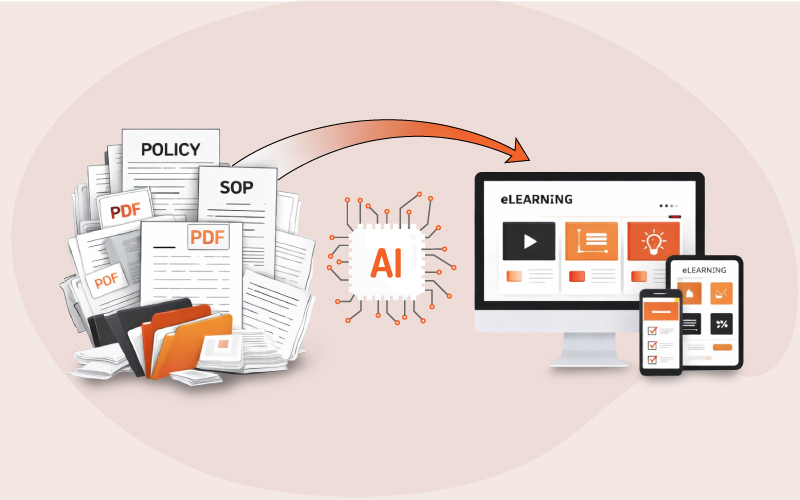
Most organizations put serious effort into defining their policies and standard operating procedures. These documents are reviewed, approved, and updated as the business, regulations, or operating conditions change. That governance discipline is usually well established.
Compliance training is typically built at a specific point in time, approved, and deployed through the LMS. As policies evolve, updates follow slower, manual cycles. Courses remain active even after rules change, and completion data continues to show participation rather than current alignment.
The gap usually becomes visible when training is examined more closely. During audits, internal reviews, or risk discussions, teams are asked to show that completed training aligns with the current approved policy.
A familiar question then follows.
When did this policy change, and when was training updated to reflect it?
At enterprise scale, this challenge shows up in a few consistent ways:
- Manual course creation cycles lag behind policy change
- Training content reflects earlier versions of approved documentation
- Evidence of alignment becomes difficult to demonstrate during review
To address this, leading regulated enterprises are changing how training is created. Instead of rewriting policies into courses, they use AI course creation for compliance training to derive learning directly from approved documentation, using platforms such as BrinX.ai, and keep it aligned as policies change.
This blog explains how regulated enterprises use AI for course creation to structure SOPs and policies into LMS-ready learning, reduce audit exposure, and maintain defensible alignment when scrutiny matters most.

Why manual course creation becomes unsafe at enterprise scale
Manual course creation becomes unsafe at enterprise scale because it cannot keep training aligned with policy changes. The growing volume, frequency, and complexity make manual alignment unreliable.
As organizations grow, human-led rewriting introduces interpretation risk and inconsistency. The resulting delays are not acceptable in regulated environments. What works for a handful of policies breaks under enterprise-wide documentation sprawl.
The false belief that manual rewriting protects accuracy
Many organizations assume rewriting policies into training improves clarity and learner understanding. In practice, rewriting introduces risk rather than control.
Every rewrite involves judgment. Language is simplified, and steps are reordered. Examples are added to improve comprehension. None of these are intentional misrepresentations. Over time, however, training reflects how individuals interpret rules rather than how those rules are formally defined.
At a small scale, this risk appears manageable. At an enterprise comes systemic.
Different regions interpret the same SOP differently. Exceptions receive emphasis in one course and disappear in another. Training accuracy becomes subjective rather than governed in large-scale AI course creation programs.
This is where AI course creation changes the equation. Not because it accelerates production, but because it enforces structural consistency across learning derived from the same source, as seen in systems such as BrinX.ai.
How inconsistency shows up during audits
Auditors rarely evaluate training in isolation. They review policies, procedures, learning content, and evidence together.
When the same SOP produces different training interpretations across departments or geographies, questions surface immediately.
- Why does one course emphasize a control that another omits?
- Why does the training sequence diverge from the approved procedure?
- Why does course language differ from policy language?
These questions do not imply bad intent. They reveal a process that does not scale safely. Compliance training requires uniform interpretation, and manual workflows struggle to deliver that reliability.

Regulated enterprise requirements for AI in eLearning
Regulated enterprises require AI in eLearning to operate as a governed system, not a creative assistant.
Control, traceability, and repeatability matter more than speed, flexibility, or content variety in AI in eLearning environments.
This distinction is critical for AI in eLearning adoption decisions. AI that generates content without constraint introduces more risk than value. AI that enforces structure reduces exposure.

Control must come before capability in AI course creation
Any use of AI in compliance learning must operate inside defined rules, structured logic, and approval workflows. It must respect source documentation and support validation, review, and sign-off across compliance, L&D, and risk functions.
For buyers evaluating AI for course creation, the first question is not what the system can generate. It is whether the system enforces alignment or encourages interpretation.

Accuracy, traceability, and repeatability are non-negotiable
A common enterprise concern is whether AI-generated compliance training can be trusted.
- When learning is derived directly from approved policies, accuracy improves.
- When every learning component links back to a specific policy section, traceability improves.
- When the same logic applies across courses and regions, repeatability improves.
These qualities are what regulators expect, regardless of whether AI in eLearning is used.

How AI safely handles real-world compliance documentation
AI supports compliance learning safely only when it handles real documentation conditions accurately. Enterprise policies are rarely clean, standardized, or consistently formatted.
Handling documentation reality, not ideal inputs
SOPs and policies often exist as scanned PDFs, legacy files, and documents filled with tables, footnotes, appendices, and embedded exceptions. Many include conditional clauses that matter during audits.
Modern document reading AI, including platforms such as BrinX.ai, is built for this reality. It supports AI to read PDF files, process scanned documents, and interpret structured and unstructured layouts. Strong AI documentation capabilities ensure conditions and exceptions are not lost.
For regulated enterprises, completeness is not optional. Missing a clause creates exposure.
Extracting obligations without reinterpretation
Not every section of a policy requires training. Some define mandatory actions and decision points. Others exist for reference.
AI to extract data from PDF content identifies obligations, controls, and decision logic while separating supporting information. The goal is noise reduction without altering meaning.
When this separation is done correctly, learning becomes clearer without becoming inaccurate.

How AI turns SOPs into structured, LMS-ready learning
AI turns SOPs into structured, LMS-ready learning by mapping policy logic directly into consistent learning frameworks.
Mapping policy logic into learning structures
Effective AI course creation begins with logic, not slides.
Policies already define sequence, conditions, and outcomes. An AI course creator uses this structure to build modules, lessons, and assessments. These elements follow the approved SOP flow.
This approach supports enterprise eLearning by delivering consistency across regions. It removes the need for repeated manual rebuilding.
Why structural alignment reduces audit risk
Reviewers can trace a learning module directly back to a policy section. Updates affect only the relevant components. Alignment becomes demonstrable rather than assumed.
This is why AI course creation for compliance training functions as a governance capability, not a productivity tool.
For teams that want to see how this approach works in practice, we have outlined a detailed example of turning SOPs and policies into eLearning using BrinX.ai.

How instructional quality is preserved without regulatory drift
Instructional quality is preserved when AI operates within defined precision boundaries, and human review focuses on validation rather than reinvention.
Defining precision boundaries clearly
Some policy language must remain exact to retain regulatory meaning. Other sections can be simplified to improve comprehension without altering intent.
Effective systems define these boundaries explicitly. AI preserves regulatory language where precision matters and simplifies only where clarity improves without changing meaning. This balance supports effective compliance training without regulatory drift.
Human review as validation, not reinvention
Human oversight remains essential, but the role changes.
Compliance and subject matter experts validate accuracy, confirm alignment, and approve outputs. They do not rewrite content from scratch.
This shift reduces review fatigue while strengthening accountability and audit confidence.

Compliance risks of introducing AI in eLearning without governance
AI increases compliance risk when introduced without governance, validation, and accountability.
Common failure modes include treating AI as a shortcut rather than a control mechanism. Others include allowing paraphrasing without validation, bypassing approval workflows, and fragmenting governance across tools or teams.
The result is predictable. Training drifts from policy and evidence becomes inconsistent. During audits, organizations struggle to explain discrepancies.
Enterprises should evaluate governance capabilities before automation features. If a system cannot enforce review, traceability, and approval, it increases exposure rather than reducing it.

Managing policy change without breaking training alignment
Continuous alignment requires targeted updates rather than full rebuilds.
Why training lags behind policy today
Policy updates trigger redesign, review, redeployment, and recertification cycles. LMS friction and cross-team coordination slow-release timelines.
By the time updates go live, another change often follows. Alignment becomes reactive rather than continuous.
How AI enables targeted updates
AI for documentation enables change detection at the policy section level. When a clause changes, only the related learning components will update. Historical records remain intact. Recertification triggers apply only where required.

Yes, when evidence continuity is preserved.
Auditors focus on traceability, not content origin. Effective systems maintain clear links from policy to learning to learner records. Historical completions remain accessible. Updates trigger recertification without erasing evidence.
Audit readiness depends on defensibility, not novelty.

Deploying AI-generated courses inside enterprise LMS environments
AI-generated courses must operate inside existing LMS governance structures, not bypass them.
They must support SCORM and xAPI, maintain reporting integrity, and adhere to approval and certification workflows. An AI-powered LMS strengthens alignment, while the LMS remains in the enhances alignment, while remaining
LMS with AI, buyers should confirm that AI in learning management system environments reinforces governance rather than bypasses it. Strong LMS AI capabilities support approvals, retraining triggers, and audit reporting.
Where AI reduces effort and where humans remain essential
AI removes mechanical work such as formatting, restructuring, duplication, and rebuilding cycles that add time without reducing risk.
Human responsibility remains for validation, regulatory sign-off, and exception handling.
Clear separation ensures safe AI course creation at scale.
When AI-driven course creation is the right choice and when it is not
AI-driven course creation works best for high-volume, policy-driven training that demands consistency and frequent updates.
Compliance refreshers, SOP onboarding, and regulatory updates benefit most. Judgment-heavy learning, such as leadership development or ethics discussions, still requires manual design, with AI providing limited structural support.

Frequently asked questions on AI course creation for compliance training
1. Can AI course creation keep compliance training aligned with SOPs and pass audits?
Yes. Compliance training remains audit-defensible when AI structures learning directly from approved SOPs and policies. What matters is clause-level traceability and clear version history. During audits, reviewers look at whether training reflected the policy in force at the time and whether that alignment can be shown consistently across learners.
2. How does AI handle real-world compliance documents such as scanned PDFs and complex SOPs?
Most enterprise policies are not clean or standardized. They include scanned files, tables, footnotes, and exceptions that are easy to miss. AI systems designed for documentation can work with this reality, but only when they are built to preserve conditions and qualifiers. If those details are lost, the risk is not technical, it is regulatory.
3. What governance controls are required when using AI for compliance training?
AI in eLearning environments must operate within defined governance controls that include version management, role-based approvals, traceability to source documentation, and auditable review records. Without these controls, AI introduces interpretation risk rather than reducing it. Governance determines whether AI functions as a compliance safeguard or a liability.
4. How quickly can policy changes be reflected in training using AI?
AI changes the update pattern rather than simply speeding it up. Instead of rebuilding full courses, changes can be applied where the policy actually changed. In practice, this means updates move faster, but more importantly, alignment is maintained without breaking historical training records.
5. Which types of compliance training are not suitable for full AI-driven course creation?
AI-driven course creation works best for rule-based, policy-driven training that requires consistency and frequent updates. It is less suitable for judgment-heavy learning such as ethics discussions or leadership development, where interpretation and human context shape outcomes.
6. What evidence is required to demonstrate audit readiness for AI-generated compliance training?
Audit readiness comes down to reconstruction. You need to show which policy was approved, how it informed the training, who reviewed it, and what version each learner completed. Auditors care about whether that chain holds together under scrutiny, not about whether AI was part of the workflow.

A practical starting point for regulated enterprises
A safe starting point is to assess documentation, maturity and governance readiness before introducing AI in eLearning.
Centralized policies, clear version control, defined review ownership, and documented approval workflows indicate readiness. Risks arise when AI is layered onto fragmented governance.
Enterprises that begin with control rather than automation achieve sustainable results with AI in eLearning.
If your organization relies on SOPs and policies to manage risk, training alignment cannot be assumed. It must be demonstrated.
BrinX.ai helps regulated enterprises structure approved documentation into LMS-ready learning while preserving traceability, governance, and audit confidence.
A practical next step is to assess:
- How long policy changes take to appear in training
- Whether alignment can be proven at clause level during an audit
- Where manual interpretation still enters the workflow
- When compliance matters, alignment is not optional.
Assess how structured AI course creation can reduce interpretation risk before your next audit cycle. Talk to a compliance learning expert.