
In 2026, the global eLearning market is estimated at $275.9 billion, continuing to grow faster than most formal education budgets across the US and Europe. That scale appears different across systems. In enterprises, learning platforms are fully deployed and heavily used, yet evidence of applied skills remains uneven.
In higher education, online enrollment has stabilized, while participation in courses varies widely by program design. Public systems show similar signals, with high platform adoption and inconsistent instructional depth.
These patterns signal fewer technology limitations and more open questions about how the future of digital learning gets designed, governed, evaluated, and sustained over time.
This blog looks at how AI, accessibility, and skills development are reshaping digital learning across education and workforce systems and why treating them separately often creates blind spots later.

How AI Is Actually Being Used in Digital Learning Systems Today
AI enters most digital learning conversations early because it already sits inside learning stacks, even when teams do not explicitly describe it as AI in education. Recommendation logic has been part of LMS design for years, and newer layers mainly make those mechanics more visible to senior leadership.
What tends to get lost in discussion is how limited that usage still is, especially once systems move from pilots into regulated or scaled environments.
Across enterprise, higher education, and public systems, AI is applied where variability can be controlled, and risk is known, which explains why expectations often move faster than outcomes.
Most deployments focus on operational lift rather than learning cognition. Routing learners to content, adjusting pacing windows, or flagging inactivity is common- because those functions align cleanly with existing governance models.
Feedback loops exist, but they are usually bound to quiz performance or completion of signals, not judgment or skill inference. In regulated enterprise environments, this constraint is deliberate rather than technical.
Personalization, Support, and the Limits Most Systems Hit
Personalization typically means sequence variation, not adaptive reasoning. In one enterprise rollout, AI was permitted to recommend modules based on role and prior activity, while any attempt to infer readiness for a task was removed during review.
Higher education systems follow a similar pattern, where AI supports student nudging but stops short of instructional decision-making.
This is where firms like MITR Learning and Media tend to operate, not by introducing features, but by defining boundaries. Translating policy language into system behavior, clarifying where automation must stop, and ensuring learning design remains defensible under audit are recurring scenarios.
The work is less visible than model selection, but it largely determines whether AI remains usable at scale.

Why Accessibility Standards Now Shape Digital Learning Design Decisions
As AI introduces more variation into learning systems, accessibility pulls design back toward consistency. That tension becomes visible quickly, especially in environments where learning serves large and diverse groups.
Personalization can adjust pacing or sequencing, but access still has to remain predictable. In practice, this is where many teams pause, not because standards are unclear, but because design and delivery implications extend further than expected.
In both the US and Europe, accessibility is no longer treated as something checked at the end. Ongoing WCAG revisions and closer ADA scrutiny have pulled accessibility into early conversations around design choices and procurement decisions.
Teams encounter it during platform evaluations, content migrations, and vendor assessments, often before instructional questions are fully resolved. Accessible learning starts to function less as a feature and more as a condition the system must meet.
That shift shows up in everyday design work. Learning teams begin to notice constraints when:
-
Authoring tools limit layout choices to preserve screen reader logic
-
Video strategies change due to caption accuracy and review effort
-
Assessments are adjusted to avoid interactions that assistive tools cannot handle
-
Content updates slow because remediation is required before release
-
Platform upgrades trigger new compliance reviews
WCAG, ADA, and Universal Design as System Constraints
Accessibility increasingly acts as architecture rather than retrofit. In one higher education system, an accessibility audit led to rewritten authoring guidelines, changing how faculty structured content from the start instead of fixing issues later.
Similar patterns appear in enterprise learning, where inclusive learning design shapes templates, media use, and assessment logic well before rolling out.
Once accessibility enters design discussions, another pattern becomes harder to ignore; content-heavy systems break differently for different users. The same module that passes compliance can still confuse, overload, or disengage, which shifts attention away from rules and toward learning effectiveness.

The Shift from Content Delivery to Skills-Based Learning Across Age Groups
Across sectors, the move toward skills-based learning becomes visible when content libraries stop answering practical questions about capability. In K12 systems, digital programs still align to curriculum, but districts increasingly look for signs that students can apply what they complete.
Higher education faces similar pressures. Course completion remains important, yet employers continue to ask what graduates can do once learning moves into real settings. Enterprises experience this most directly, where growing catalogs do not always translate into workforce readiness.
The challenge often lies with visibility. Skills frameworks create useful structures, but they rarely connect cleanly to existing learning assets.
A single course might reference several skills without showing depth, while a short activity may demonstrate capability if it reflects real tasks. Measurement follows uneven paths, relying on completion or self-reporting because clearer signals are harder to design.
Why Content Completion No Longer Signals Capability
Completion once offered reassurance. It no longer carries the same weight.
Inferring skills requires linking activity to outcomes, which exposes gaps between design intent and actual use. In one organization, hundreds of courses were mapped to a framework, yet managers still hesitated to assign work based on transcripts alone.
This is where MITR often supports teams, helping connect learning activity to skill evidence instead of adding volume. Design choices focus on relevance, so learning aligns with how skills are demonstrated across age groups and work contexts.
As skills frameworks take center stage, another question follows closely, whether learners actually stay with systems long enough to build those capabilities. Participation patterns, drop-offs, and quiet fatigue begin to surface, especially in large programs, shifting attention toward engagement as a defining factor in the future of digital learning.

Engagement Challenges in Digital Learning Across Education and Work
Engagement becomes visible once learning systems scale, even when content libraries, skills models, and accessibility checks appear stable. In schools, universities, and workplaces, participation often thins out unevenly. Learners open modules, skim material, and move on, while activities tied closely to tasks or assessments hold attention longer. The pattern usually reflects how systems are structured rather than how motivated learners feel.
Most platforms still rely on a small set of signals to interpret this behavior, even though those signals were never designed to explain usefulness.
| What Systems Often Track | What It Is Assumed to Show | What It Usually Reflects in Practice |
|---|---|---|
| Logins and Access Counts | Interest and participation | Compliance behavior or forced entry points |
| Time Spent in Modules | Attention and focus | Open tabs, idle time, or slow navigation |
| Completion Rates | Learning progress | Task closure without capability change |
| Click Activity | Engagement with content | Interface interaction, not relevance |
| Survey Satisfaction | Survey Satisfaction | Short-term reaction, not performance shift |
When Engagement Drops, Measurement Usually Lags
Measurement rarely adjusts when engagement weakens. Proxy metrics remain in place because they are easy to collect, even when task performance or workflow outcomes stay unchanged. Over time, this gap makes it harder to distinguish system fatigue from genuine learning values.
As engagement weakens, the issue rarely sits with content volume or platform choice alone. It points to something more basic, whether learning connects to real decisions and produces evidence that holds up outside the system.
Relevance and proof begin to matter more than participation, which brings design, measurement, and human judgment back into the same frame.

Measurement, Relevance, and Human-Centered Design as the Common Thread
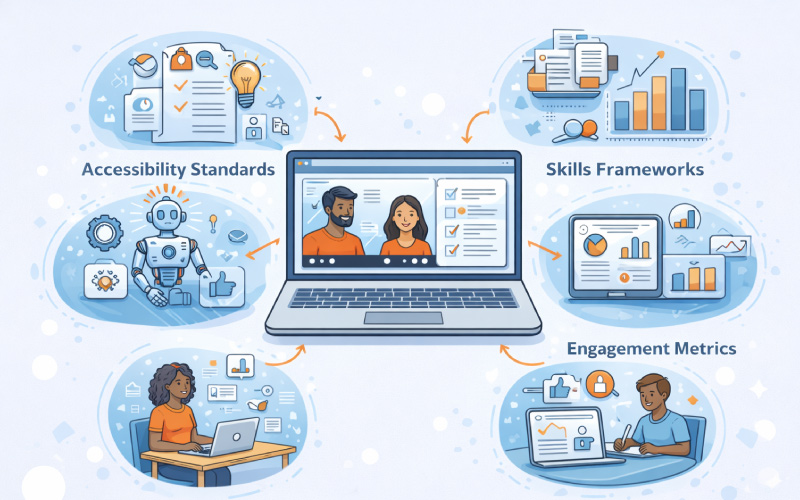
Once AI systems, accessibility standards, skills-based learning models, and engagement metrics sit side by side, measurement becomes the connective tissue holding them together.
What gets measured determines what survives review, whether in regulated AI in education environments, enterprise audits, or cross-border programs shaped by digital learning trends USA Europe.
Relevance follows closely.
Learning that cannot be evidenced- or explained outside the platform struggles to justify its place in the broader future of digital learning. Human-centered design enters here without sentiment. It shows up in decisions about cognitive load, task alignment, and system clarity, especially when accessible learning and inclusive learning design impose constraints that remove ambiguity.
These constraints are not limited in practice as they force clearer intent and cleaner evidence.
MITR operates most visibly, and its work tends to sit between regulation, learning design, and proof. In one enterprise environment, policy language around AI usage was translated into concrete design rules that governed feedback, data visibility, and review cycles.
In another, skills evidence was reworked, so learning activity aligned with operational decisions, not transcripts alone. Across sectors, MITR functions as a systems-level design partner, bridging learning intent with evidence that holds up under scrutiny.
Measurement often becomes the point where earlier decisions finally meet reality.
When relevance is clear and evidence holds, questions around AI use, accessibility choices, skills mapping, and engagement stop competing for attention. They begin to connect through shared constraints and shared accountability.
At that stage, learning design is less about adding structure and more about removing friction, especially where systems span regions, roles, and regulatory expectations. The work tends to slow down here, not because progress stops, but because clarity matters more than speed.
To explore the next practical steps, connect with MITR Learning and Media.
FAQs
1. What is learning ecosystem transformation?
A learning ecosystem transformation is the redesign of how learning is created, delivered, connected, and measured across K12, Higher Ed, and Enterprise environments. It aligns media, data, and design to ensure learning becomes continuous, measurable, and future-ready.
2. Why is media essential in modern learning ecosystems?
Media improves attention, emotional engagement, and comprehension. Visual storytelling helps learners grasp complex ideas faster, whether in schools or enterprise settings. In MITR’s ecosystem, media plays a central role in making learning memorable and meaningful.
3. How does data improve the way we learn?
Data helps educators and organizations identify gaps, measure progress, personalize learning, and improve performance. MITR applies data-driven insights to ensure learning outcomes are not assumed, they’re understood.
4. How does design shape scalable learning ecosystems?
Design ensures learning experiences are structured, accessible, and outcome-focused. Clear sequencing, intentional flow, and cognitive principles make content easier to absorb and apply. MITR uses design as the backbone of every learning experience it builds.
5. What roles do upside learning, mynd, and BrinX.ai play?
Upside learning strengthens mitr’s ecosystem with science-backed instructional design, analytics, and enterprise capability frameworks.
mynd enhances enterprise learning through high-end media and storytelling, influencing how MITR approaches creative engagement.
Brinx.Ai accelerates content creation across segments, turning raw content into structured learning modules with AI precision.
6. How does MITR support both education and enterprise globally?
MITR works across Asia, Europe, the Middle East, and the USA to unify learning principles and capability frameworks across schools, campuses, and organizations, all under one connected ecosystem philosophy.

Soft Skills Deserve a Smarter Solution
Soft skills training is more than simply information. It is about influencing how individuals think, feel, and act at work, with coworkers, clients, and leaders. That requires intention, nuance, and trust.