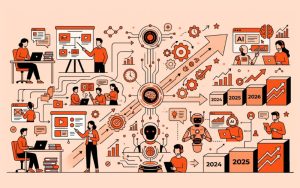


Many L&D teams notice that training demand has been rising in a steady, almost background way. It is rarely a major shift that triggers it. More often, it comes from small operational tweaks, policy clarifications, or tool updates that keep landing on the team’s desk.
Each one creates work that moves into the queue, and over time, the pace starts to feel different. Even minor updates still need interpretation and some level of review, which means they compete with the larger commitments already in motion.
When these requests move through workflows built for slower, project-based cycles, the strain becomes visible. Leaders who trace this movement often see that demand now increases faster than traditional models can accommodate, prompting a deeper look at underlying constraints.

Training Demand Now Moves Faster Than L&D Can Respond
In many organizations, the operational environment evolves more frequently than L&D processes were designed to handle. A system receives a permissions update; a compliance team issues a clarification to an existing rule, or a workflow that affects several business units is restructured.
None of these events appear significant in isolation, yet together they produce an ongoing influx of requests.
Even teams with strong coordination feel the strain when these requests arrive in parallel, because the traditional development approach still depends on sequential decision-making, structured reviews, and linear production steps.
Stakeholders often believe these requests are minor and therefore easy to accommodate. However, small changes still require accurate interpretation, drafting, validation, and release. When dozens of such updates enter the queue within a quarter, they collectively reshape L&D’s capacity.
Work that once felt evenly distributed begins to cluster, and teams start carrying backlogs that grow quietly beneath larger priorities.
As teams try to understand why they cannot absorb increasing demand simply by adding more resources or adjusting priorities, they frequently find that the constraint lies in the architecture of the workflow itself.
This recognition becomes an important turning point because it reframes the discussion from a staffing challenge to a process design challenge. And once that framing settles, the natural next step is to look closely at the specific points in the workflow where movement slows.
This leads directly into the examination of operational bottlenecks and why they tend to persist even in teams that believe they have optimized their processes.

The Operational Bottleneck Behind Most Delays
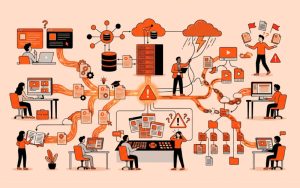
When instructional development relies on a segmented structure, each segment introduces its own timing, dependencies, and variability. Drafts move between tools. Reviews occur according to the availability of SMEs and approvers.
Content requires formatting and packaging steps that often happen late in the process. Even when each segment functions reasonably well, the movement between segments introduces delays that accumulate over time.
What appears manageable at low volume becomes increasingly complex under steady or rising demand.
Several recurring issues emerge across many enterprises L&D groups and reveal how bottlenecks form in environments that rely heavily on linear sequences:
Intake information is delivered without operational details that designers require for accurate structuring
Review cycles expand because different reviewers prioritize different criteria, creating inconsistent expectations
Redundant content is generated because existing materials are stored in disconnected repositories without effective metadata
SMEs contribute at intervals that do not match development schedules, creating long pauses between steps
Formatting tasks absorb more time than anticipated because they involve multiple systems or templates
Version management becomes difficult as content moves across channels without unified tracking
These issues demonstrate that the challenge is not simply one of capacity. It is one of the designs. A workflow meant for predictable, project-based development does not adapt easily to environments where content needs emerge continuously and at varied levels of urgency.
Once teams acknowledge this, they begin to consider whether a different structural approach could better support ongoing production. This line of thinking often brings them to the concept of development pipelines, which operate on fundamentally different principles than traditional project workflows.

Why A Pipeline Model Changes Output Dynamics
A pipeline approach reframes instructional development by prioritizing flow rather than step-by-step progression. Content enters the pipeline with defined inputs and moves through a consistent series of transformations that follow predetermined logic. Instead of requiring designers to make structural decisions repeatedly, the pipeline provides patterns that streamline assembly.
Reviews occur at specific decision points tied to instructional or compliance of thresholds rather than subjective preferences. The model reduces variability by embedding constraints that simplify how content is produced.
Some organizations adopt pieces of this model without labeling it a pipeline. A department may standardize its template usage, which reduces the number of formatting decisions designers must make. Another may unify its storage locations, improve reuse, and reduce duplication.
A third may implement structured review criteria that limit back-and-forth iterations. Each of these changes reduces friction in ways that support higher throughput, even when the team has not formalized a full pipeline.
Eventually, teams notice that these incremental improvements resemble the underlying mechanics of continuous development systems used in technical and operational functions. The connection becomes clearer as volume increases, and the need for consistent flow becomes more pronounced.
At that point, L&D leaders begin asking not whether pipelines make sense, but what a rapid-learning pipeline would look like when applied thoughtfully inside an enterprise context. This naturally transitions into examining the components that make such a pipeline function in practice.

What Rapid-Learning Pipelines Look Like in Practice
Rapid-learning pipelines bring structure to content development by ensuring that each piece of work enters the system with clarity and progress through stages that minimize decision-making overhead.
The pipeline does not eliminate human judgment; it organizes it so that judgment is applied where it adds the most value. Teams can then navigate high volumes without losing consistency or slowing down under the weight of recurrent tasks.
Although organizations customize these pipelines to their unique environments, certain elements appear consistently because they address constraints that many teams face. These elements include:
-
Intake structures that capture operational context and reduce ambiguity earlier in the process
-
Predefined design patterns that streamline drafting and ensure content aligns with organizational norms
-
Review decision points that maintain quality without expanding cycles unnecessarily
-
Parallel development lanes that allow multiple assets to progress simultaneously through different stages
-
Automated formatting procedures that limit late-stage production delays
-
Standardized metadata rules that preserve content traceability and support long-term reuse
When these elements work together, the pipeline operates as a stable system rather than a set of isolated tasks, and teams see a steadier flow even when the volume shifts. Tracking progress becomes simpler, which helps planning reflect what the team can actually deliver.
Once this steadiness appears, leaders usually examine what kind of infrastructure can support it without adding more administrative work.
That review often points toward orchestration tools that interpret inputs, organize movement, and keep content consistent. This is the point where BrinX.ai becomes a practical anchor for the entire pipeline.

Why BrinX.ai Becomes the Backbone for High-Volume Production
A rapid-learning pipeline requires a coordinating layer that can manage the flow of content, interpret varied inputs, guide components through structured pathways, and automate tasks that do not require human judgment.
BrinX.ai provides this orchestration environment by embedding intelligence into the workflow, enabling the system to maintain consistent logic across modules while adapting to the practical realities of enterprise operations.
Organizations see the impact most clearly when reviewing the specific areas where BrinX.ai strengthens pipeline performance:
-
Interpreting intake information and structuring initial content components according to established patterns
-
Maintaining alignment with template logic to ensure predictable content organization
-
Enabling parallel generation of related modules through automated drafting mechanisms
-
Coordinating reviews by linking decision criteria to roles and responsibilities
-
Automating assembly, formatting, and media adjustments that traditionally require manual work
-
Tracking version lineage and metadata to support reuse and long-term maintenance
When these capabilities stabilize the pipeline, the development process becomes less dependent on sequential human coordination and more reflective of a continuous operational system.
L&D teams gain clearer visibility into workflow movement, enabling them to plan work based on actual throughput rather than assumed capacity. This helps them manage rising demand with greater resilience, especially as organizational change accelerates through 2026.
The Shift Toward Pipeline-Based Learning Operations
As enterprise environments continue to evolve rapidly, learning teams face the challenge of supporting operational change with instructional systems built for earlier, slower cycles.
The shift toward rapid-learning pipelines reflects an acknowledgment that modern training functions require architectural support, not just more effort or reorganized task lists. Pipelines create the stability needed to balance continuous demand with predictable output, and their effectiveness becomes increasingly visible as volume grows.
For organizations considering this transition, the most reliable results tend to emerge when pipelines are supported by orchestration platforms designed for complex, high-volume instructional environments.
BrinX.ai provides this foundation by enabling structured flow, automated production, and consistent content logic, giving L&D teams the operational stability required for modern development cycles.

FAQs
What is AI in eLearning?
AI in eLearning refers to the use of artificial intelligence tools and models to automate, personalize, and optimize instructional design and learning delivery.
How is AI transforming instructional design?
AI is reshaping instructional design by automating repetitive tasks, generating data-driven insights, and enabling adaptive learning paths so designers can focus on creativity and strategy.
Can AI replace instructional designers?
No. AI enhances instructional design by managing mechanical tasks, allowing designers to invest their time in creativity, empathy, and alignment with business goals.
What are the benefits of using AI in eLearning?
Key benefits include faster course creation, adaptive personalization, smarter assessments, better learner analytics, and continuous improvement through feedback loops.
How does BrinX.ai use AI for instructional design?
BrinX.ai automates course structure, pacing, and assessment logic using AI-driven design principles, while maintaining strong version control and governance.
What challenges come with AI in eLearning?
The main challenges include ethical oversight, data bias, intellectual property questions, and ensuring human judgment remains central in the design process.
What instructional design models work best with AI?
Models like ADDIE, SAM, and Gagne’s 9 Events integrate seamlessly with AI, turning static frameworks into dynamic, data-responsive design systems.
How can AI improve learner engagement?
AI supports adaptive content, predictive nudges, and personalized reinforcement, aligning with motivation models like ARCS and Self-Determination Theory.
Is AI-driven learning content ethical?
It can be, when guided by transparency, inclusivity, and diverse data sets, ensuring that algorithms serve learning rather than bias it.
What’s next for AI in instructional design?
Expect AI to drive conversational learning, generative storytelling, and predictive analytics that anticipate learner needs before they arise.

Soft Skills Deserve a Smarter Solution
Soft skills training is more than simply information. It is about influencing how individuals think, feel, and act at work, with coworkers, clients, and leaders. That requires intention, nuance, and trust.