

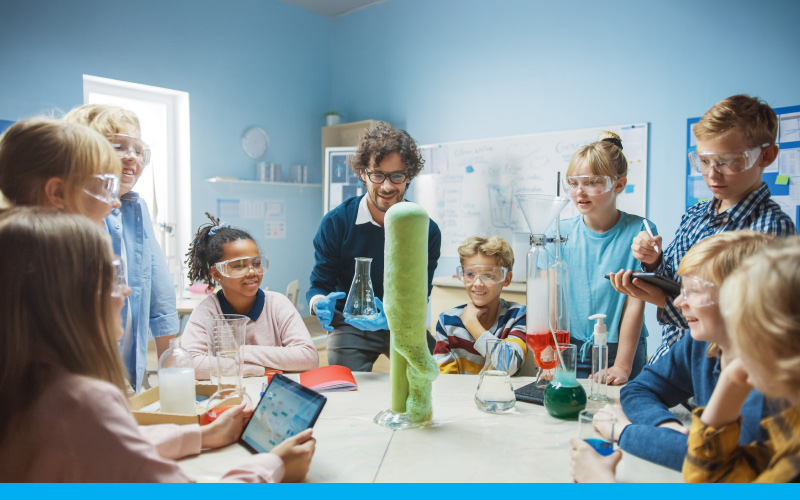
An interesting pattern has appeared in recent district reports. Enrollment in advanced math tracks is steady, but participation in project-based electives that blend design and technical tasks has risen faster. The correlation is rough, but it suggests that students are not avoiding analytical work.
They may simply want environments where the analytical and the interpretive sit closer together. It raises an old question again, though in a different form. Whether STEM as a structured framework still captures the competencies students actually use when solving open-ended problems.
This is where STEAM education enters, not as an upgrade to STEM but as a practical shift in how schools define readiness.

How Creativity Is Moving into Core Curriculum
Many systems began with the assumption that creativity belonged in elective courses. Over time, several found that students demonstrated stronger problem-solving skills when creative tasks were introduced in subjects that originally avoided them. A science class that allowed visual reasoning produced lab reports with clearer causal explanations.
A computer science project that included narrative framing made debugging faster because students articulated intent more directly. These observations may look small, yet they accumulate across grades, creating a pattern that districts cannot overlook.
STEAM education fits into this environment because it treats creativity as a method rather than a theme. It gives teachers structured permission to use interpretive tasks in subjects that were previously evaluated only on accuracy.
The shift is gradual, though noticeable.
Teachers begin reworking assignments to allow for more autonomy. Rubrics adjust to measure clarity of reasoning rather than memorization. Students attempt more variants of solutions because the format invites exploration.
A few working indicators tend to signal that creativity has moved into the academic core.
-
Students begin producing explanations that reference assumptions, not just outcomes.
-
Teachers start revisiting how they model thinking aloud during demonstrations.
-
Project duration gets extended because the inquiry takes longer than fixed-answer tasks.
-
Assessment committees question whether existing tools measure the right things.
The pattern is not uniform, yet it shows how creativity alters the workflow of instruction. Once that workflow expands, STEM feels too narrow to hold the range of competencies emerging in classrooms.
And once that tension becomes visible, conversations naturally shift to how these competencies influence readiness for later academic and workplace environments. The next logical discussion usually centers on how learning structures handle this growing blend of analytical and creative work.
So, the focus turns toward integration.

Why Integration Matters More Than Categorization
Schools often reorganize programs by labeling subjects, but categorization alone rarely changes how students think. Integrated models create different behaviors. For instance, when a middle school combines physics concepts with simple prototyping exercises, students tend to articulate cause and effect with more precision.
They also revisit earlier assumptions without prompting because the physical object exposes flaws sooner. This differs from categorizing the same content under two subjects, which keeps thinking compartmentalized.
Integration also influences teacher practice.
In districts where math and art departments collaborated on spatial reasoning modules, teachers reported that students showed better retention of geometric principles.
Not because the content changed, but because students processed relationships more concretely when reasoning was tied to something they created. The creative element acted as a stabilizer, anchoring the abstract.
These classroom shifts do not happen automatically. They often require instructional teams to rethink timelines, materials, and evaluation points. Many schools underestimate the planning required, which eventually leads them to reconsider what they expect integration to accomplish.
Integration is less about mixing disciplines and more about aligning tasks with the type of cognitive action students must perform. Clear alignment supports more accurate assessment and more sustainable teaching practices.
As districts move deeper into integration efforts, they run into another persistent question. A recurring question is which specific skills become more pronounced when creativity and analytical work intersect. Data from several pilot programs provides a hint, though the trends require cautious interpretation. Still, they indicate that creativity often drives students to approach ambiguity differently.
And that behavior change becomes important when identifying the next category of focus: problem-solving patterns that shift once creative reasoning is embedded into instruction.
This is where the conversation moves next.

How Problem-Solving Behaviors Change in STEAM Settings
Problem-solving skills are often treated as a general capability, yet the behaviors within that category change depending on the instructional environment. In settings influenced by STEAM education, the differences show up in workflow rather than outcomes. Students spend more time clarifying the question before attempting solutions.
They develop provisional drafts more frequently. Peer reviews become more substantive- because input is not limited to checking correctness. These changes accumulate and alter the pace of classroom work.
One point that educators note is how ambiguity becomes more manageable. Students appear less concerned about having the correct approach on the first attempt. They iterate more readily and rely on mixed reasoning forms.
A math-oriented student might sketch a diagram to validate understanding. A design-oriented student might use symbolic reasoning to test a sequence. The cross-patterning produces a more durable form of problem-solving because the student is not anchored to a single method.
When reviewing performance logs from STEAM-based courses, three recurring tendencies emerge.
-
Students widen the range of evidence they draw from, shifting between quantitative and qualitative cues.
-
They show greater willingness to revisit instructions, not because of confusion but to refine their interpretation.
-
They collaborate earlier in the process, often before forming a complete idea.
-
They pause to articulate uncertainty in functional terms, which improves clarity for both peers and teachers.
These are practical behaviors, not theoretical differences. Teachers observe them in the flow of work, which explains why many districts treat STEAM not as an enrichment model but as a mechanism for improving the reliability of student reasoning. Once problem-solving workflows stabilize, policy teams begin asking a different question.
Whether creativity in classrooms contributes to readiness for environments beyond K12. If thinking patterns shift internally, there may be implications for the broader idea of future-ready learning.
This usually leads to the next step in the discussion.

How Creativity Supports Future-Ready Learning
Future-ready learning is often linked to digital skills, though the more reliable indicator is how students handle uncertainty. Creativity affects that directly by giving them room to adjust constraints instead of treating every instruction as fixed.
Schools observing STEAM classrooms notice recurring behaviors.
A few markers stand out:
-
Students move iteration habits from one subject to another without deliberate instruction.
-
They tolerate ambiguity with less hesitation.
-
Their documentation becomes clearer because it supports multi-step reasoning.
-
Coherence becomes a more stable priority than correctness.
These habits gradually become routine- students revisit decisions without assuming errors and approach unfamiliar tasks with fewer pauses. As the pattern becomes more consistent, creativity shifts from an add-on to a structural part of curriculum planning.
That shift usually brings districts back to the broader question of whether existing STEM boundaries still match the competencies they see emerging. The next step is to consider how these changes influence long-term curriculum design.
Where the Shift Eventually Settles
Creativity is not replacing STEM. Schools still rely on structured analytical instruction to maintain academic rigor. The shift is quieter. Creativity becomes the connective logic that allows students to interpret their tasks with more agency.
This changes the pace of learning, the quality of reasoning, and the way teachers structure work. The changes are small at first, then consistent, then too embedded to reverse.
Many districts treat these developments as practical adjustments instead of philosophical shifts, which may be why STEAM education fits neatly into their existing plans. It does not overhaul the system- it recalibrates.
And once creativity is treated as a functional part of academic work, it becomes easier to recognize how the next generation might engage with problems that do not follow predictable patterns.
The adjustment continues, but its direction is clear.
FAQ's
Why is accessibility essential to STEM education for students with special needs?
Accessibility to STEM eLearning means that all students (of both genders and with special needs) get to be partakers of learning programs. It's a step towards eliminating educational inequalities and fostering multiverse innovation.
In STEM education, what are some common problems encountered by students with special needs?
Some common issues are course format that is not complex, non-adapted labs and visuals, insufficient assistive technologies, and no customized learning resources. Besides this, systemic issues such as learning materials that are not inclusive, and teachers who are not trained.
How can accessibility be improved in STEM eLearning through Universal Design for Learning (UDL)?
Through flexible teaching and assessment methods, UDL improves accessibility in STEM content. Also, UDL allows learners to access and engage content in multiple ways and demonstrate understanding of content.
What are effective multisensory learning strategies for accessible STEM education?
Examples of multisensory learning strategies in accessible STEM include when students use graphs with alt-text, auditory descriptions of course materials, tactile models for visual learners through touch, captioned videos for auditory learners, and interactive simulations to allow boys and girls choice in how they have access to physical, visual, auditory, video and written content representation.
Identify the assistive technologies required for providing accessible STEM material?
In order to provide access to STEM material, technologies like screen readers, specially designed input app for mathematics, braille displays, accessible graphing calculators are required.
How can STEM educators approach designing assessments for students with special needs?
To create content for students with special needs, tactics such as creating adaptive learning pathways in more than one format, oral and project assessments and multiway feedback will prove to be beneficial.
What is the role of schools and policymakers in supporting accessible STEM education?
Educational institutions should focus on educating trainers and support staff, also they can invest in assistive technology, and work towards curricular policies.
Can you share examples of successful accessible STEM education initiatives?
Initiatives like PhET Interactive Simulations, Khan Academy accessible learning resources, Labster virtual laboratory simulations, and Girls Who Code’s outreach are examples of effective practice.
How can Mitr Media assist in creating accessible STEM educational content?
Mitr Media is focused on designing and building inclusive e-learning platforms and multimedia materials with accessibility standards in mind so that STEM material is usable by all learners at different levels of need.
What value does partner with Mitr Media bring to institutions aiming for inclusive STEM education?
Mitr Media has expertise in implementing assistive technology, enacting Universal Design for Learning, and providing ongoing support to transformation organizations, enabling their STEM curriculum into an accessible and interesting learning experience.