
A MITR Learning & Media Expert Report for 2026
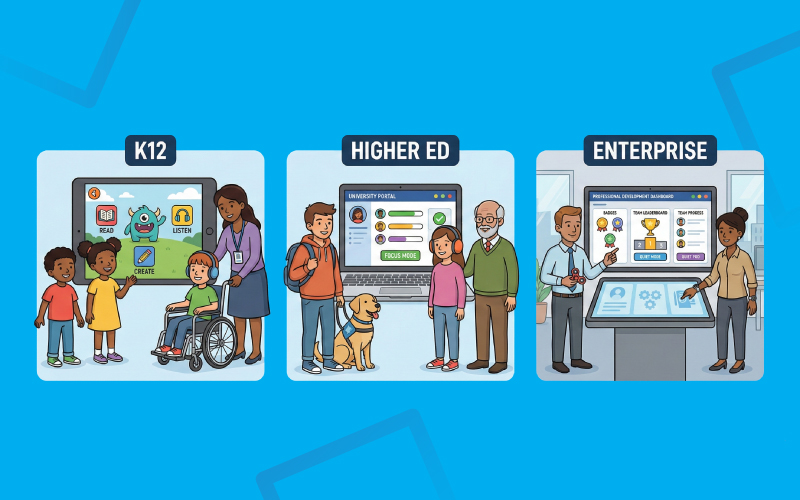
At Mitr Learning & Media, we work across enterprise L&D, K12 districts, and higher education institutions worldwide. Regardless of the sector, one pattern is consistent: learners engage more deeply when educational experiences are designed to support the full spectrum of cognitive diversity.
In all three industries, gamification has emerged as a key engagement tactic. However, as universities update digital learning environments, K12 schools broaden inclusive education requirements, and companies promote neurodiversity recruiting practices, we face a common strategic question:
Can gamification be intentionally designed to support neurodivergent learners while maintaining instructional rigor?
Our answer, informed by large-scale implementations and learner analytics, is unequivocal. Yes. When grounded in learning science and inclusive design, gamification becomes a structured, psychologically safe, and highly motivating environment for all learners.
This report presents Mitr Learning & Media’s 2026 guidance for learning leaders, instructional design teams, curriculum specialists, and academic technologists seeking to architect inclusive, scalable learning ecosystems.

The Context: Why Gamification and Neurodiversity Must Be Designed Together
Across enterprises, K12 classrooms, and university programs, neurodivergent learners often benefit from the same instructional elements:
-
Predictable structures
-
Clear and consistent cues
-
Reduced cognitive load
-
Flexible pacing
-
Supportive, actionable feedback
-
Autonomy and choice
-
Multimodal learning pathways
These align directly with instructional design models such as Gagne’s 9 Events, ARCS, Bloom’s Taxonomy, and Self-Determination Theory.
Gamification operationalizes these models in a dynamic, scalable format:
-
In corporate L&D, this looks like guided branching scenarios and adaptive challenge levels.
-
In K12, it can mean leveled tasks, structured routines, and supportive hints.
-
In higher education, it becomes adaptive simulations, practice modes, and reflective checkpoints.
When intentional, gamification becomes one of the strongest tools for universal learning access.

What’s Not Working: Traditional Gamification Fails Neurodiverse Learners
In the ecosystems Mitr Learning & Media evaluates, outdated gamification patterns appear across all sectors.
1. Sensory overload
Overuse of animations, sounds, or visual density increases cognitive load and reduces clarity. Cognitive Load Theory warns against this.
2. Timed challenges by default
Mandatory timers create anxiety for learners with ADHD, dyslexia, or processing differences.
This affects all sectors, from K12 math apps to higher ed simulations to enterprise compliance modules.
3. Competition-centric motivation
Leaderboards and competitive scoring reward speed rather than mastery.
This discourages reflective learners and fails to support motivational diversity.
4. Rigid, linear difficulty progression
Uniform difficulty curves disregard variable processing speeds and cognitive pacing.
These issues do not invalidate gamification. They highlight the need for a more intentional, inclusive model.

The Solution: Mitr Learning & Media’s 2026 Framework for Inclusive Gamification
Our 2026 framework is built on flexibility, feedback precision, cognitive alignment, and equitable access. It applies seamlessly to enterprise L&D, K12 instruction, and higher education.
1. Choice-driven pathways
Learners choose challenge levels, pacing, or modes of engagement.
Aligned to Self-Determination Theory.
-
Enterprise: practice vs. assessment modes
-
K12: leveled tasks or hint-enabled modes
-
Higher ed: divergent research or simulation paths
2. Reduced cognitive load
Clean layouts, predictable navigation, and simplified interactions benefit all learners but are essential for neurodivergent ones.
3. Mastery-based progression
Replace time-based and speed-based scoring with mastery-driven advancement.
This aligns with Bloom’s Apply and Analyze stages.
4. Transparent, supportive feedback
Feedback must be constructive, instructive, and immediate.
This supports confidence-building per ARCS.
5. Adaptive, data-driven difficulty
Dynamic challenge scaling personalizes learner journeys without creating frustration cycles.
6. Optional competition
Maintain leaderboards or peer challenges as opt-in features.
7. Dual-coded, sensory-aware design
Visuals paired with concise text reduce cognitive friction and support comprehension.
This model enhances rigor and accessibility simultaneously.

Practical Guidance Across Enterprise, K12, and Higher Education
For Enterprise L&D Teams
-
Run neurodiversity audits on compliance and leadership modules.
-
Use SAM for early prototyping and rapid feedback cycles.
-
Build reusable gamification components for consistency across global programs.
For K12 Educators and District Leaders
-
Align game elements with IEP accommodations and universal design for learning.
-
Provide flexible pacing and non-timed options.
-
Use predictable routines to reduce cognitive friction.
For Higher Education Instructional Designers and Faculty
-
Integrate mastery-based gamification into LMS modules and simulation labs.
-
Add reflective prompts to deepen metacognition.
-
Use analytics to personalize pathways in large-scale courses.
Across all sectors, spaced reinforcement, through microlearning boosters or periodic nudges, improves long–term retention.

Case Insights from Mitr Learning & Media
Enterprise Case
We redesigned a multinational bank’s compliance training using adaptive challenge modes and supportive feedback. Completion rates increased significantly, and accuracy in scenario-based tasks improved across global regions.
K12 Case
A district-level math program implemented tiered challenges, simplified UI design, and audio-visual support. Students with ADHD and dyslexia reported higher confidence and lower frustration. Teachers reported improved sustained attention.
Higher Education Case
A university’s nursing simulations were transformed into adaptive pathways with optional practice modes. Neurodivergent learners reported improved comprehension and performed better in applied clinical reasoning assessments.
These outcomes demonstrate that inclusive gamification is equally powerful across sectors.

Common Pitfalls to Avoid
1. Designing for entertainment instead of learning outcomes
Gamification is an instructional tool, not an aesthetic layer.
2. Ignoring accessibility requirements
WCAG-aligned contrast, alt text, and keyboard navigation are foundational, not optional.
3. Overly complex mechanics
Complexity must support cognition, not distract from it.
4. Assuming inclusive design weakens rigor
Inclusion increases clarity, not ease.
5. A single reward system for all learners
Different learners and sectors require different motivators.

Conclusion
At Mitr Learning & Media, we view inclusive gamification as a key component in the architecture of the learning environment for 2026. Gamification is a potent equalizer that supports neurodiverse learners in businesses, K–12 schools, and higher education when it is based on research, accessibility, and customisation.
Measurable learning outcomes are improved, confidence is bolstered, engagement is increased, and cognitive diversity is supported through inclusive gamification.
If your organization, district, or institution is building or modernizing learning ecosystems, Mitr Learning & Media is ready to support evaluation, design, and implementation.

FAQs
What is AI in eLearning?
AI in eLearning refers to the use of artificial intelligence tools and models to automate, personalize, and optimize instructional design and learning delivery.
How is AI transforming instructional design?
AI is reshaping instructional design by automating repetitive tasks, generating data-driven insights, and enabling adaptive learning paths so designers can focus on creativity and strategy.
Can AI replace instructional designers?
No. AI enhances instructional design by managing mechanical tasks, allowing designers to invest their time in creativity, empathy, and alignment with business goals.
What are the benefits of using AI in eLearning?
Key benefits include faster course creation, adaptive personalization, smarter assessments, better learner analytics, and continuous improvement through feedback loops.
How does BrinX.ai use AI for instructional design?
BrinX.ai automates course structure, pacing, and assessment logic using AI-driven design principles, while maintaining strong version control and governance.
What challenges come with AI in eLearning?
The main challenges include ethical oversight, data bias, intellectual property questions, and ensuring human judgment remains central in the design process.
What instructional design models work best with AI?
Models like ADDIE, SAM, and Gagne’s 9 Events integrate seamlessly with AI, turning static frameworks into dynamic, data-responsive design systems.
How can AI improve learner engagement?
AI supports adaptive content, predictive nudges, and personalized reinforcement, aligning with motivation models like ARCS and Self-Determination Theory.
Is AI-driven learning content ethical?
It can be, when guided by transparency, inclusivity, and diverse data sets, ensuring that algorithms serve learning rather than bias it.
What’s next for AI in instructional design?
Expect AI to drive conversational learning, generative storytelling, and predictive analytics that anticipate learner needs before they arise.

Soft Skills Deserve a Smarter Solution
Soft skills training is more than simply information. It is about influencing how individuals think, feel, and act at work, with coworkers, clients, and leaders. That requires intention, nuance, and trust.